There are so many spider plant varieties - can you name them all?
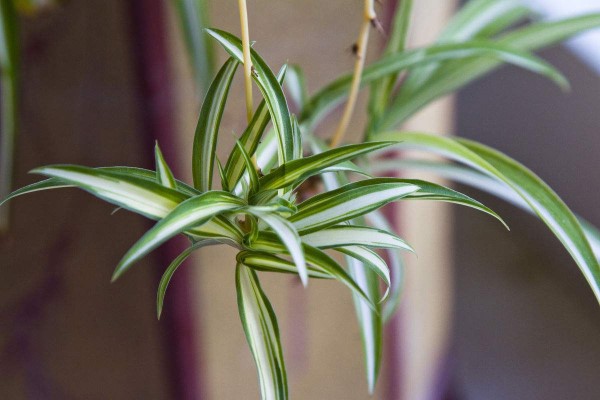
Green-leaf spider plant
The green-leaf spider plant is the most common type of spider plant. Its leaves are slender, emerald green, and have no obvious patterns or stripes on the surface.
The green-leaf spider plant can bloom, and its cold resistance and drought tolerance are both relatively strong, making it very easy to care for.
Variegated spider plant
The variegated spider plant is also called the purple spider plant. Its leaves are relatively small and yellowish-white, and the veins are purple. The variegated spider plant is rich in color and, seen from a distance, looks dignified and elegant.
The variegated spider plant likes a warm environment with indirect scattered light. During its growing season, pay attention to applying light fertilizer frequently, and also spray water on the leaves often.
Silver-heart spider plant
The leaf shape of the silver-heart spider plant is similar to that of the green-leaf spider plant - both are thin and long. The difference from the green-leaf spider plant is that the edges of the silver-heart spider plant's leaves are emerald green, but the middle part of the leaf has silver-white stripes, which is very eye-catching.
When growing the silver-heart spider plant, pay attention to keeping it warm in winter, and also make sure to maintain a well-ventilated environment.
Silver-edge spider plant
The leaf color pattern of the silver-edge spider plant is the opposite of the silver-heart spider plant. The edges of the silver-edge spider plant's leaves are silver-white, and the middle part is emerald green.
The silver-edge spider plant likes a warm and humid environment. You can sprinkle water around it in the morning and evening to maintain air humidity.
Golden-heart spider plant
As can be seen from the name, the golden-heart spider plant should be similar to the silver-heart spider plant. The difference is that the middle part of the golden-heart spider plant's leaves is golden.
The care of the golden-heart spider plant is not much different from that of ordinary spider plants. You can repot it every 2 or 3 years to increase the spider plant's growth rate.
Golden-edge spider plant
Likewise, the only difference between the golden-edge spider plant and the golden-heart spider plant is that the edges of the golden-edge spider plant's leaves are golden, while the middle is green.
When caring for the golden-edge spider plant, pay attention to avoiding direct summer sunlight, and also apply less nitrogen fertilizer to prevent the leaves from losing color.
Thousand-leaf spider plant
The leaves of the thousand-leaf spider plant are relatively small, and the leaf shape is round. The thousand-leaf spider plant has many branches and leaves, tightly clustered together and very pleasing to the eye.
The thousand-leaf spider plant likes a warm and humid environment, is not strict about light, and has relatively strong cold tolerance.
Peony spider plant
Strictly speaking, the peony spider plant is not a type of spider plant. Because the peony spider plant's stems are relatively soft and look somewhat similar to spider plants, it has always been treated as a spider plant. The peony spider plant's leaves are relatively thick, and its rose-red flowers are very small and cute.
The peony spider plant likes an environment with ample light and dryness. During the growing season, its water demand is relatively large, and its cold tolerance is not strong.
Goldfish spider plant
The goldfish spider plant gets its name because the color and shape of its flowers are similar to cute little goldfish. The goldfish spider plant has emerald green leaves. When it blooms, the goldfish-shaped flowers set it off beautifully, giving it very high ornamental value.
The goldfish spider plant is shade-tolerant and can grow in a fully shady environment. It likes water, so the soil of the goldfish spider plant should be kept slightly moist.
Pearl spider plant
Although the pearl spider plant has "spider plant" in its name, it is actually a type of succulent. The pearl spider plant is what everyone knows as the string of pearls. Its leaves are like small, cute beads strung together and hanging down, unique and lovely.
The pearl spider plant should be cared for in an environment with scattered light. In summer, pay attention to shading, and in spring and autumn, nitrogen fertilizer can be applied appropriately.
Lipstick spider plant
The lipstick spider plant is very easy to identify because it gets its name from the shape of its flowers, which resemble tubes of brightly colored lipstick. The lipstick spider plant's leaves are relatively thick, and it is especially beautiful when it grows into a full pot.
The lipstick spider plant should be placed in a cool, ventilated place, avoiding direct sunlight. During the growing season, its water demand is large, so it should be watered frequently to keep the soil moist.
Bridal veil spider plant
The bridal veil spider plant is a spider plant variety whose name alone sounds very romantic. The bridal veil spider plant's leaves are very small, and the small white flowers it produces are also very small and delicate. Placing a pot of bridal veil spider plant on the balcony, seen from a distance, is dreamy and beautiful.
The bridal veil spider plant likes a high-temperature, high-humidity environment and likes sunlight; its shade tolerance is not strong.
That is all for the introduction to spider plant varieties~
Come and identify which type the spider plant you are growing at home actually is!