The shari trunk transforms into a cloud-piercing arrow, the bonsai styling is simply stunning
Inspiration for the work:
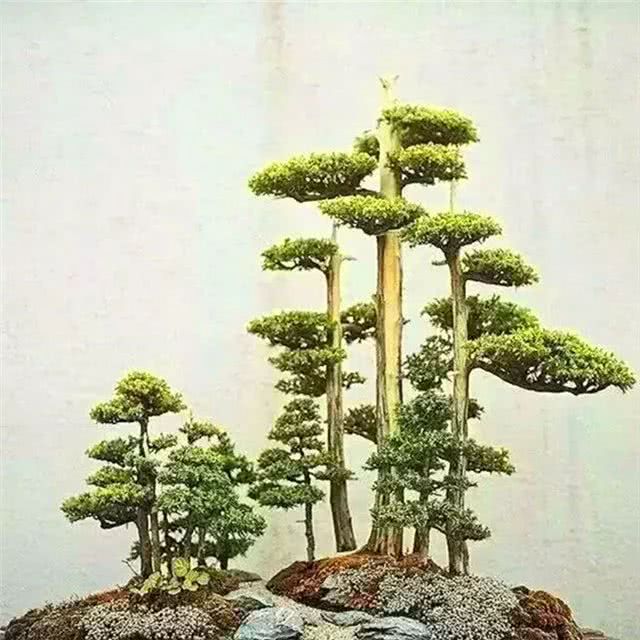
A juniper bonsai work I came across by chance, this shari-style landscape first sparked my inspiration; every old tree in nature has weathered wind, frost, rain and snow, lightning and thunder, endured nature's battering, gone through round after round of lush dense growth, and time after time of bark peeling, causing the wood to become bleached white. This kind of natural mountain-and-wild composition, where the bark at the trunk or branch tips peels away, is called a natural "kami", while the localized bleached white wood on the trunk is called shari;
This is the original photo of this shari bonsai, with a forest-style layout;
Tank specifications: 1200X500X500
Lighting: Xiyu 70W, 2 units
Filtration: Jianrong CF1400 filter canister, 1 unit
Materials: acid-washed Qinglong stone, Yangtze No.1 no-wash cosmetic sand, oak tree stump, azalea root branches, Lanbao aquatic plant soil
Aquatic plants: dwarf hairgrass, Qingmu fern, green hygrophila pot grass, triangle moss;
Oak tree stump, azalea root branches;
Use a machete to sharpen the front end of the tree stump into a point, then also shave off the bark that needs to be removed, making it into shari, then use an electric drill to bore holes at the spots where branches are to be joined, and use skeleton glue to stick the branches onto the trunk. Make it into a tree crown! Also, the direction of the branches must be consistent;
Now take a look at the finished tree stump, doesn't it look very much like it!
The bottom of the tree stump is fixed to a thick plastic board with a stainless steel screw, mainly to reinforce the center of gravity, and also so it won't fall over when arranging the skeleton; furthermore, when aquatic plant soil is spread on top of the plastic board, the tree stump won't float up due to the buoyancy of the water;
The entire forest landscape is mainly divided into 2 parts;
Use Qinglong stone to enclose the skeleton, with the middle part serving as the river channel. Then use expanding foam to fix the stones in place, to prevent the aquatic plant soil inside from slipping out through the gaps and affecting the landscape quality;
After the expanding foam dries, spread cosmetic sand in front of the skeleton, and spread aquatic plant soil behind it to plant the aquatic plants.
Small triangle moss is glued onto the tree crown, now take a look at the overall effect after spreading the cosmetic sand!
Start adding water, after a night of filtration, now take a look at the entire planted tank forest landscape;
- End -
May every aquatic plant enthusiast get a bag of fish food that is worth the money!