Keep these flowers at home, and an old gardener says it is like adding a beautiful landscape
Some friends who want to grow flowers do not know which plants to start with, nor which plant varieties are highly ornamental, with special and lush plants? Want your home to become a landscape because of a few plants? Then do not miss the following varieties.
Have you ever heard of or come into contact with these four plants: Euphorbia neriifolia, Sedum sarmentosum, Epiphyllum oxypetalum, and Aizoaceae? If not, then through the introduction below, you may develop some different feelings.
Euphorbia neriifolia
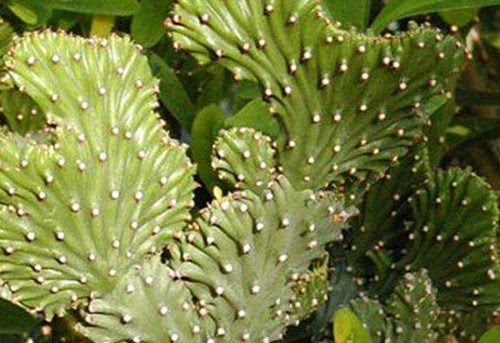
Euphorbia neriifolia is a perennial herbaceous plant of the genus Euphorbia in the family Euphorbiaceae, also known as qilin jiao, yu qilin, and so on, and is a variant of Euphorbia royleana. Its appearance is very distinctive, with its ridged succulent stems transformed into a cockscomb shape or a flat fan shape, giving it very special ornamental value. Its place of origin is the India region, and it is suitable for arid, hot, and sunny growing environments. There are not many key points for growing Euphorbia neriifolia. It likes light and needs to be placed in a sunny environment, and must not be left for long in a dark indoor place, otherwise the leaves will turn yellow and fall off. The potting soil can be made by mixing leaf mold, coal cinder, and garden soil in equal proportions of 1/3 each. Euphorbia neriifolia has strong drought tolerance, and the soil should be kept rather dry than wet. When watering, wait until the potting soil becomes hard and white before watering. For example, in spring and autumn, when the average temperature is around ten-plus degrees, watering once every 10 days on average is enough. Euphorbia neriifolia is not cold-tolerant, and after Frost's Descent it needs to be brought indoors. Only when the winter temperature is above 15 degrees will it not drop leaves. As for fertilizer, this plant does not like fertilizer much, and the principle for supplying fertilizer is rather less than more, rather light than concentrated.
Sedum sarmentosum
Sedum sarmentosum is a perennial succulent herbaceous plant of the genus Sedum in the family Crassulaceae. Its stems are slender, and slender adventitious roots can be seen on some nodes. Leaves are in whorls of 3, and the leaf blades are oblanceolate to oblong, green in color, succulent, with the leaf tip nearly acute, the base abruptly narrowed, and with a spur. This is a traditional Chinese medicine, sweet in nature, bland in nature, and cool in nature. It has the effects of draining dampness and reducing jaundice, and clearing heat and detoxifying. It can be used as a courtyard ornamental plant, and can also be grown indoors for hanging display. Sweet, bland, cool. It has the effects of draining dampness and reducing jaundice, and clearing heat and detoxifying. Sedum sarmentosum is extremely tolerant of poor soil and can adapt to general soil, while sandy loam with good drainage is most suitable for growing it. It blooms when exposed to sunlight, and closes in the early morning, evening, and on cloudy days, so it is also called wushi hua. It likes moisture, and usually needs a certain level of humidity maintained. During the growing season it needs sufficient watering. Sedum sarmentosum has strong cold tolerance but is not tolerant of strong light, and needs shading in summer. As for fertilizer, topdressing once every half month with 0.1 percent potassium dihydrogen phosphate can keep it blooming continuously with bright colors. Apart from that, there are not many growing requirements.
Epiphyllum oxypetalum
Epiphyllum oxypetalum, also known as qionghua, tanhua, guizai hua, weituo hua, and so on, is an epiphytic succulent shrub of the genus Epiphyllum in the family Cactaceae. It can reach 2-6 m in height, and its old stems are cylindrical and woody in nature. It has many branches, and the leaves are laterally flattened in shape, with leaf blades lanceolate to oblong-lanceolate, and leaf margins wavy or with deep rounded teeth. Its base is acute, shortly acuminate, or gradually narrowed into a stalk-like form. The leaf color is dark green, the surface is hairless, and branches of old plants can produce aerial roots. Epiphyllum oxypetalum flowers are solitary in the small areoles on the sides of the branches, funnel-shaped in flower form, opening at night, with the flowering time lasting only 1-2 hours. It is called the "Beauty Under the Moon," and because the time is too short, it has left behind the idiom "a fleeting show of Epiphyllum." Its petal-like tepals are white, obovate-lanceolate to obovate. Its berry is long-spherical, with longitudinal ridges, hairless on the surface, and purplish-red in color. Seeds are numerous, ovate-reniform, bright black, with a wrinkled surface, and hairless. It likes a warm, humid, semi-shaded environment, is not tolerant of frost, and avoids strong light and sun exposure. It needs shading in summer, and especially its temperature requirements are higher than in its place of origin. The suitable growing temperature is 15-25°C, and in winter it can tolerate low temperatures of around 5°C. As for soil requirements, it is best to use slightly acidic sandy soil rich in humus, with good drainage, and loose and fertile. In summer, the potting soil should be kept moist and must not be waterlogged. In winter, watering must be strictly controlled, and it is enough to keep the potting soil not too dry. In autumn, decomposed liquid fertilizer can be applied as a top dressing. Without enough nutrients, it is not easy to bloom or it blooms little. During the growing period, apply decomposed cake fertilizer water once every half month, and ferrous sulfate can also be added and applied at the same time. During the bud emergence and flowering period, applying one additional top dressing of bone meal or superphosphate can make the flowers large and white, and proper fertilizer and water application can also prolong the flowering time.
Aizoaceae
Aizoaceae is a family in the order Caryophyllales of the class Dicotyledoneae, with about 126 genera and 1,100 species. In China there are a few species such as the genera Mollugo, Gisekia, Sesuvium, Trianthema, and Tetragonia. Most are annual or perennial herbs, or semi-shrubs. The stems of Aizoaceae are erect or prostrate, with simple leaves opposite, alternate, or falsely whorled, sometimes succulent, sometimes small, with leaf blades entire, rarely with sparse teeth; stipules are scarious. Flowers are bisexual, actinomorphic, solitary, clustered, or in cymes; with a single perianth or differentiated perianth. Its fruit is a capsule or nut-like, sometimes an achene, often surrounded by a persistent perianth; seeds have a slender curved embryo, surrounded by floury endosperm, and often have an aril. Aizoaceae plants need a sunny, cool, and dry environment, are tolerant of semi-shade, afraid of waterlogging, and avoid muggy and humid conditions. Most have the habit of growing in cool seasons and going dormant at high summer temperatures. They need to keep the soil moist for a long time, basically cut off water throughout winter, and usually need to avoid water accumulation. The soil can use coal cinder mixed with peat and a small amount of perlite, in a ratio of roughly 5:4:1.
These four plant types are rich in varieties, and they are not too conventional and ordinary plant varieties. As long as you have them at home and in the courtyard, they can naturally become one or several beautiful landscape lines. Flower lovers who want to obtain some unusual and special beauty should not miss them.
How much more do you know about the topic of this article? You are welcome to share your views in the comment section below. If you like this article, you might as well subscribe, and more wonderful articles will be shared with you.