Cingjing building ban conditionally lifted, environmental groups worry that 90% illegally built homestays will crush the environment
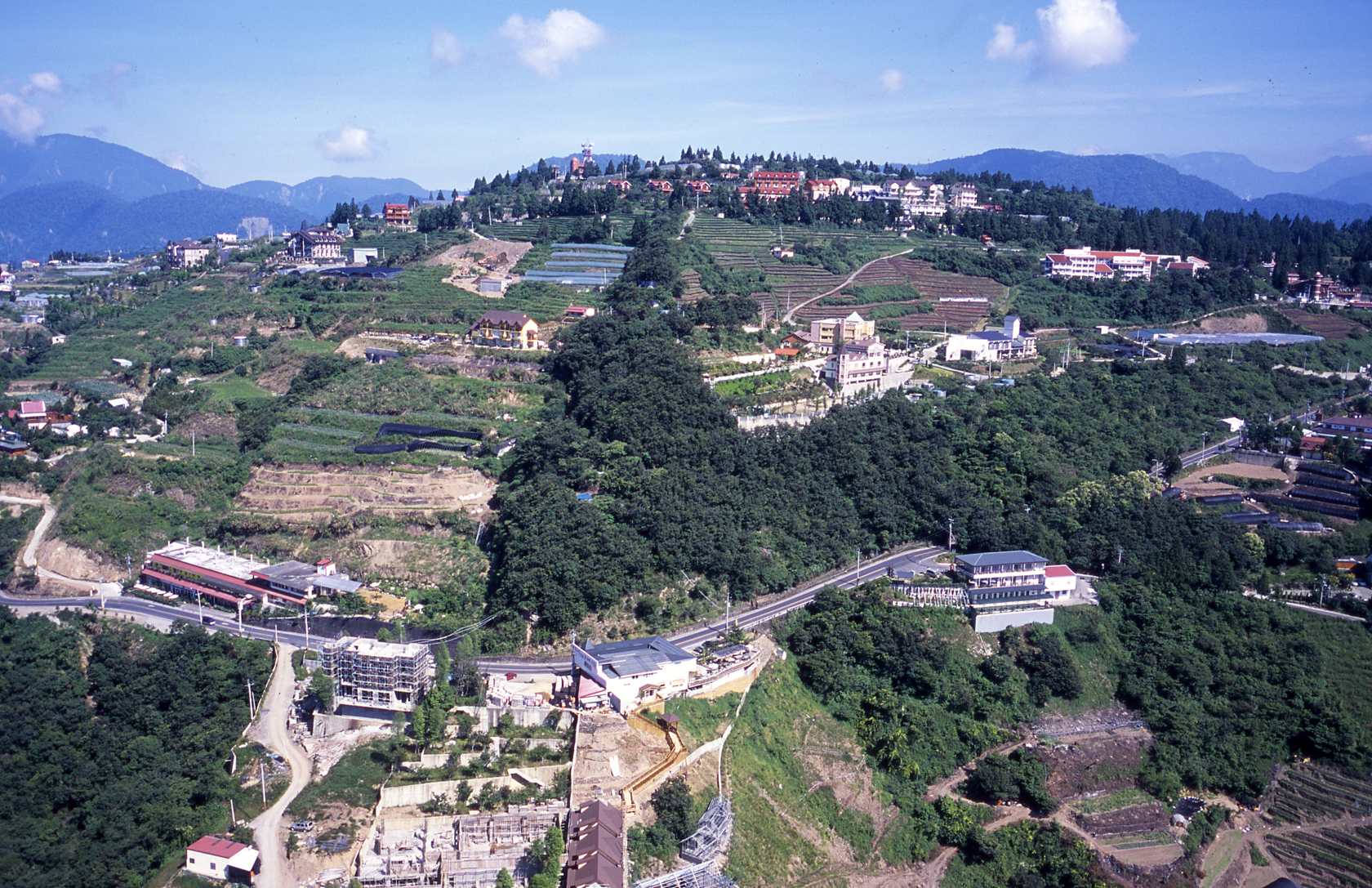
Cingjing Farm is a famous domestic tourist attraction, but more than 90% of its homestays are illegally built, and the Central Geological Survey has also announced that 60% of Cingjing Farm's land is located in landslide, landslip or geologically sensitive areas. However, the Nantou County Government recently resolved to conditionally lift the "prohibition and restriction on construction" order in the Cingjing area. This move has drawn questions from environmental groups, who say that failing to deal with existing illegal homestays and now opening up development is equivalent to the last straw that breaks the camel's back.
(60% of Cingjing Farm's land is located in landslide, landslip or geologically sensitive areas. Video filmed and provided by / Citizens of the Earth Foundation)
The prohibition and restriction on construction for over-limit use of slopeland in Cingjing will be lifted on May 15 this year
Li Cheng-wei, Director of the Construction Department of the Nantou County Government, said that when Typhoon Morakot struck, a large-scale collapse occurred in the Lushan area of Ren'ai Township, prompting a review of the problem of over-limit use of slopeland. Therefore, the county government implemented the "prohibition and restriction on construction" order in May 2012, fully suspending the issuance of building permits in the Cingjing area. During this period it was extended twice, and it will expire on May 15 this year.
As the extension period was about to expire, Nantou County Magistrate Lin Ming-chen stated that continuing the construction prohibition and restriction could provoke public resentment, and instructed that it be conditionally lifted. Li Cheng-wei pointed out that because of the "prohibition and restriction on construction" order, local residents could not expand their buildings: "When children grow up there is nowhere for them to live. If the house needs to be expanded, or an old house needs renovation, they cannot get a permit."
Li repeatedly emphasized that this is not a full lifting of the ban, but is aimed at old residential communities such as Zhongxiao New Village and Rongguang New Village; only these buildable land areas are relaxed. For ordinary homestays or hotels, the ban is still not lifted, and over-limit use remains controlled as before.
But will lifting the "prohibition and restriction on construction" order make conditions worse in the environmentally sensitive Cingjing area? Li said that in the case of Zhongxiao New Village, there were already houses there, single-story townhouses, and in the future they could be rebuilt into two-story buildings. "This is within the permitted scope and buildable land, and will not make the situation worse."
60% of Cingjing Farm's land is located in landslide, landslip or geologically sensitive areas, and 90% of homestays are in violation
According to statistics from the Construction and Planning Agency of the Ministry of the Interior, Cingjing has a total area of 497 hectares, of which 219 hectares are forestry land, accounting for 44%; followed in order by 177 hectares of agricultural and pastoral land, accounting for 35%; 52 hectares of recreational land, accounting for 10%; and 8 hectares of building land, accounting for 1%. The Central Geological Survey also previously announced that 60% of Cingjing Farm's land is located in landslide, landslip or geologically sensitive areas.
How can development avoid the environmental sensitive areas that make up as much as 60%? Li explained that when a building permit is submitted, if it is ordinary building land and not in an environmentally sensitive area, that part is reviewed and submitted as usual; but if it is buildable land yet located in an environmentally sensitive area, it will be approved through a stricter project review process. The county government will also regularly inspect illegal buildings, and new illegal buildings will be reported and demolished immediately, and in large development areas it is impossible for new illegal buildings to appear.
However, many homestays already exist in Cingjing's high geological disaster risk areas, which could cause disasters. Li responded that as early as the 80s of the Republic of China era, building permits were issued by the township office. These homestays obtained building permits, first built farmhouses, and later expanded with illegal construction. The county government has listed 112 homestays for supervision and regularly inspects them, and 80% to 90% of them have violations. "But the county government does not have enough manpower or budget. The entire county's annual budget is only 1 million, and demolishing one building costs 300,000 to 400,000. This year three have already been demolished."

Citizens of the Earth Foundation: After the ban is lifted, how will illegal homestays be handled?
Li pointed out that what the county government is doing is taking back the authority to issue building permits, changing it so that the county government issues permits, and immediately reporting and demolishing new illegal buildings so that illegal construction does not spread. But how should existing illegal homestays be handled? Li said they will be resolved together under the subsequent national land plan. Through geological surveys, according to the results of geological assessments, if development is not allowed, these homestays will have to relocate.
The Citizens of the Earth Foundation said that most of the Cingjing area is slopeland agricultural and pastoral land, and the pattern of violations by these homestays is the same as the situation with farmhouses in Yilan. Most first build farmhouses on farmland, legally obtain building permits, and then add illegal structures. The county government could originally handle illegal buildings under the Regional Plan Act, but the county government uses insufficient budget as an excuse.
Wu Chi-jung, a specialist in the Mountain and Land Group of the Citizens of the Earth Foundation, pointed out that the county government's past approach of implementing the "prohibition and restriction on construction" order is indeed questionable, and this conditional lifting is not entirely wrong either. "But the key point is that existing development is all in violation. How is the government going to face this? It is not enough to simply lift the 'prohibition and restriction on construction' order."
Wu emphasized that existing violations should be dealt with first, all information on illegal homestays should be made public, and only then should subsequent lifting be carried out. "It is a fact that homestays are constantly proliferating. If things are relaxed, how will these existing violations be guided? Or will another wave of violations be allowed to appear?"
Taiwan Mountain Forest Restoration Association: Lifting the prohibition and restriction on construction will make things worse for Cingjing
"Lifting the 'prohibition and restriction on construction' order is equivalent to adding frost to snow for the Cingjing area. Opening up will be the last straw that breaks the camel's back." Tsai Chih-hao, chairman of the Taiwan Mountain Forest Restoration Association, said directly that the Cingjing area is a special zone, located at mid-altitude with high rainfall and unstable strata, and is a fragile area. Development must take forest protection and overall safety into consideration.
Tsai further explained, "What the county government should face is the problem of existing illegal construction exceeding standards. How should it face the homestays that are already in violation? How should the aftermath be handled? Should it be like Lushan, where the local government turns a blind eye and lets the whole area collapse?" He emphasized that lifting the "prohibition and restriction on construction" order is not the point. The county government should pragmatically face the problems of over-limit use and illegal construction. That is the core.
Tsai said that in recent years, not being able to develop because of the construction prohibition and restriction has indeed been harm and loss for landowners; but it is also a fact that 90% of homestays are illegally built. "Where exactly is the county government's standard? It bans legal ones but does not deal with existing violations." Tsai emphasized that the Cingjing area must be used at low density, taking regional safety and ecological conservation into consideration together, and that how mountainous areas should be reasonably used must be re-examined.