Don't throw away succulent flower stalks - pinch them off and stick them in soil and they'll survive 100% of the time
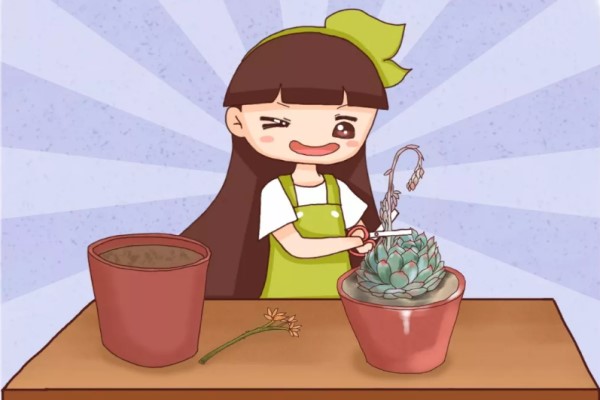
Stick the flower stalk in soil and it'll rapidly grow new shoots
The flower stalk has absorbed a large amount of nutrients from the mother succulent, and once stuck in soil, the survival rate is 100%, growing roots vigorously and sprouting plump side shoots!
1. Flower stalks of Crassulaceae succulents are suitable for cuttings
Not all succulent flower stalks can be used for cuttings. Most Crassulaceae succulent flower stalks can be used for cuttings, such as Echeveria derenbergii, Echeveria purpusorum, and Orostachys furusei.
2. Cut off the flower stalk and let the wound dry
Find a pair of sterilized scissors, cut off the flower stalk, and place it in a cool, ventilated area to let the wound dry. The flower stalk must have leaves on it for new shoots to emerge from the leaf veins. If the flower stalk has bloomed, pinch off the flowers to reduce nutrient consumption.
3. Insert the flower stalk into soil
The soil can be a mix of river sand, vermiculite, and pine needle soil. First water the soil a little to make it slightly moist, then insert the flower stalk. Don't insert it too deep - just enough for the flower stalk to stand steadily. Finally, move it to indirect light.
4. In 15-30 days, new shoots will rapidly emerge
When the soil dries out, water a small amount to keep it slightly moist. Generally, after about 15 to 30 days, new shoots will rapidly emerge from the leaf veins. The flower stalk will root relatively quickly, usually in about 2 weeks.
Pinch off the flower head and side shoots will rapidly sprout
Pinching off the flower head of the flower stalk may cause new side shoots to grow - what a surprise! If you don't believe it, take a look!
1. Suitable for Crassulaceae, Haworthia and other succulents
The method of pinching off the flower head to make new side shoots grow from the flower stalk can be used for Crassulaceae succulents and Haworthia-type succulents. Those who grow these two types of succulents at home, don't throw away the flower stalks anymore!
2. Pinch off the flower head
When pinching off the flower head, try to choose a position lower down on the flower stalk, keeping three or four leaves at the lower position, so as to leave growth points for the side shoots.
3. Burst out with plump ball-like side shoots
After the flower head of the Crassulaceae 'Moon Goddess' was pinched off, it actually grew fully variegated side shoots - what a huge surprise! And the Haworthia cooperi also sprouted adorable side shoots!
The small leaves on the flower stalk - twist them off and throw them in soil, guaranteed to survive!
Since the flower stalk has accumulated a lot of nutrients, although the leaves on it are very small, the nutrients must be very abundant. Twist them off and throw them in soil, and they'll definitely grow like crazy!
1. Twist off the leaves and let them dry
Use your hands to twist off the small leaves from the flower stalk and place them in a cool, ventilated area to let the wounds dry.
2. Insert the leaves into soil
Prepare sterilized, clean river sand, water it a little to keep the river sand moist, insert the leaves with dried wounds into the river sand, and place in indirect light.
3. In about 20-30 days, new shoots will grow
When the river sand dries out, water a little to keep it slightly moist. Generally, in about 20-30 days, small shoots will emerge.
Use flower stalks to cultivate new succulent varieties!
Gardeners can also use flower stalks to hand-pollinate succulents, letting them produce seeds and cultivate new varieties.
1. Prepare two succulents that are blooming at the same time
To cultivate a new variety, first make sure you have two succulents blooming at the same time, so that cross-pollination between different plants can be done.
2. Distinguish between stamens and pistils
Before hand-pollinating succulents, first identify the stamens and pistils clearly.
3. Remove the stamens from both succulents
Remove the stamens from both succulents. You can use tweezers to gently pluck them off, being careful not to touch the pistil in the middle. Place the removed stamens on a saucer and label which succulent's stamens they are.
4. Hand pollination
Here, cross-pollination is to be carried out: use the stamens of the first plant to touch the pistil of the second plant, and use the stamens of the second plant to touch the pistil of the first plant. You can make contact several times to increase the success rate of hand pollination.
5. Record the cross-pollination information
On a small piece of paper, write clearly which succulent is the mother plant and which is the father plant, and tie it to the pollinated flower. The mother plant provides the ovary - that is, whichever succulent's pistil was used during pollination. The father plant provides the pollen - that is, whichever succulent's stamens were used during pollination.
6. Seeds mature
After hand pollination is complete, just patiently wait for the seeds to grow and mature. When the seed pods crack open and you can see the seeds, it means they have matured. You can place a small pot underneath to catch the falling seeds.
Has the succulent you're growing grown a flower stalk?
If it has a flower stalk,
then try the method Huahua mentioned!
If you think what Huahua said is useful,
then share it with others to take a look!