What is the difference between Lychnis coronata and Dianthus chinensis? A quick guide to tell them apart
I. Lychnis coronata
It belongs to the Caryophyllaceae family and is a plant that can live for many years. Its flowers are raceme-shaped, clustered together, very large, and generally grow at the top of the branches. It is usually grown for only two years. The stem is very smooth, and the number of branches is relatively large. It likes sunlight, can endure severe cold, can tolerate drought, fears waterlogging, and likes well-drained, breathable, fertile soil, preferably sandy soil. It originates from Southern Europe, survives in relatively large numbers in the hotter South China region of our country, and is cultivated in many places across the country. Its legend is very beautiful, expressing longing for a lover far away. Its name sounds very nice, and many people like it.
II. Dianthus chinensis
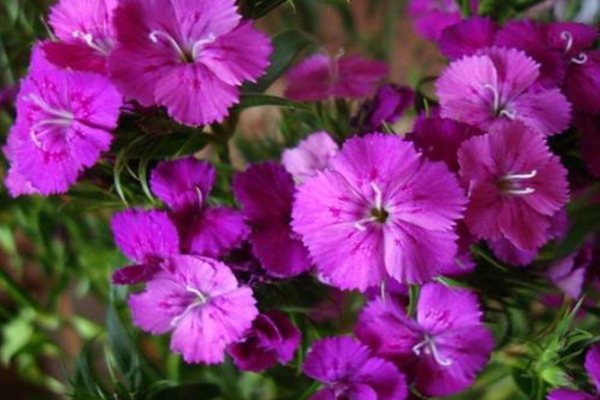
It also belongs to the Caryophyllaceae family and is generally also cultivated as a biennial flower. Its leaves grow in opposite pairs and are generally linear or broadly needle-shaped. The flowers are solitary and come in colors such as pink, red, purple, and white. There are not only single-petaled types but also double-petaled ones, and all are very fragrant. It generally blooms from April to October, and many bloom in April and May. Its seeds are round but relatively flat and dark brown. If kept indoors, it is recommended to place it on a balcony, because it likes sunlight relatively much and does not need frequent watering. As long as it is not ignored for a very long time, there will not be any problems.
III. Differences
1. These two flowers belong to the same family, but there are still differences. The first is the flower form. The latter has relatively long leaves, like lanceolate leaves, and the leaves grow opposite each other. Its flowers are relatively large, with serrated edges. The former is a horticultural variety of the latter. The former's plant is more upright, harder, and more brittle, and its inflorescence has mutated and become a raceme, with many flowers clustered together.
2. The latter has more colors than the former. The latter also has a bicolor flower, with red and white edges. If used as cut flowers, the latter is generally combined into a bouquet of different colors, while the former is generally made into a bouquet of one color.