What is the difference between golden osmanthus and silver osmanthus? How to tell them apart
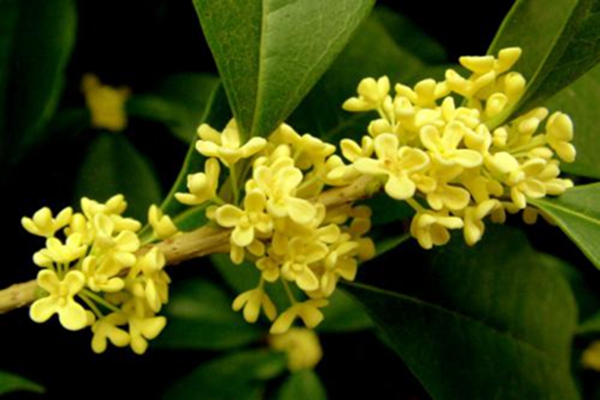
I. Golden osmanthus
Its flowers are very golden yellow, its fragrance is very rich, and its leaves are relatively thick. It can stay green all year round, and it is relatively small in size, a type of tree. The color of its branches is a light brown, and its leaves are generally opposite, tending toward a long oval shape, or a relatively broad lanceolate shape. Both ends are fairly pointed, the upper leaf edges are serrated, and the flowers grow in the leaf axils as umbel-like inflorescences, with fairly small pedicels; at first the flower color is pale yellow. Later it turns golden yellow, and it blooms in September.
II. Silver osmanthus
Its flower color is much lighter than the former's, slightly yellowish, leaning more toward white, and its scent is not very strong; its leaves are thinner than the former's. It is also a small tree that is emerald green all year round, with very dense branches and leaves, and it has two types, female trees and male trees. The leaves are oval-shaped, opposite, with the upper part relatively short and slightly pointed, and dark green in color; the flowers cluster into umbels, the corolla spreads open, and each petal is oval in shape. Its fragrance is relatively fresh and delicate, and it can be used to make tea; it also blooms in September.
III. Differences
1. For a very long period, osmanthus remains in a state without flowers; the leaves of both are relatively narrow and long, the former a bit longer, and both have very obvious tips. The former grows taller and larger than the latter.
2. The former's leaves are thicker than the latter's; the former's leaves are slightly broader and a bit curled, while the latter's tend toward an oblong shape, with leaf edges like wavy lines.
3. The buds that grow out of the former are more upright and purplish-red, turning green as they grow. The latter's new buds are copper-colored, then slowly turn green, and it grows more new shoots.