A common landscaping plant in parks, it is extremely tolerant of pruning and can be shaped into all kinds of forms.
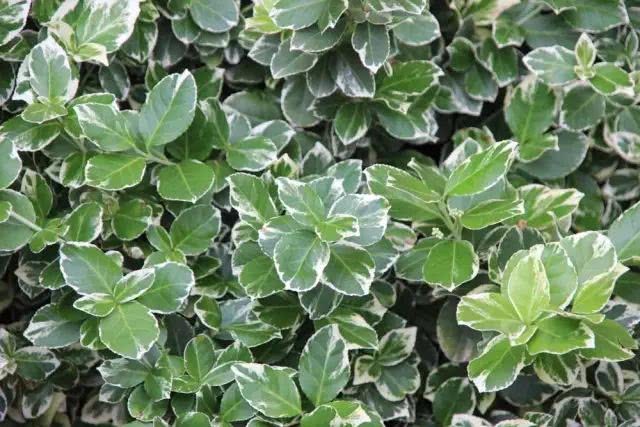
Most euonymus are evergreen trees that do not lose their leaves in winter, also called evergreen euonymus. Some people also call it large-leaf boxwood, because like boxwood it is very well suited to making hedges, and it is the most common in parks.
Among all small shrubs, euonymus may be the most common. It is very easy to grow, its leaves are beautiful, and it is almost trouble-free. So in park flower beds, it is almost the most common.
(Golden-edged climbing euonymus)
Euonymus is mainly native to our country. In the past, the common euonymus was mostly pure green, but now the most popular is green edged with golden yellow, called "golden-edged climbing euonymus".
(Climbing euonymus)
The euonymus that is green edged with white is called "climbing euonymus". The patterns can vary greatly. Recently there are types with longer leaves and long-shaped patterns. These leaves are at their most beautiful when they first emerge, while older leaves are paler in color.
Euonymus also blooms, but the flowers are very small, white or pink and round, clustered in the center. Inside are orange seeds, very attractive to birds. But many parts of the plant are toxic to humans, so you should wash your hands after pruning.
In fact, euonymus is also one of the most diverse plants. It can be grown into a shrub, can climb walls, can be used as a ground cover, and can also fill any gap in a flower bed.
Euonymus can be pruned into any shape. Although euonymus is generally quite short, not exceeding three chi. But if not pruned, the branches can grow very long and quickly cover a patch of ground.
(Lovely shapes)
The climbing variety is called "climbing euonymus", most with all-green leaves. This type can grow very long, and if planted by a wall with a support, it can cover an entire wall.
(Single-trunk euonymus)
Because of euonymus's plasticity, many people use it to make hedges, or prune it into different animal shapes, and it is also sometimes made into a small single-trunk tree.
(Fire-red flame euonymus)
There are many kinds of euonymus. One whose leaves turn blood-red in autumn is called "flame euonymus". It is actually also a kind of euonymus. This type is a deciduous tree, with no leaves in winter.
Euonymus is very vigorous, can tolerate urban environments, and is also very drought-tolerant. But it needs sunlight and cannot take full shade. In addition, it cannot tolerate poorly drained soil. When planting, the hole should be dug large, and plenty of fertile soil should be added, preferably with extra compost soil, animal compost and other good soil.
One essential task in growing euonymus is pruning, because without pruning it may grow too long and too straggly. To make euonymus grow dense, you must prune every year. At most you can cut off one third of the length. If it is used as a hedge, it must be pruned regularly.
Although euonymus is very vigorous, some varieties are more prone to powdery mildew. It is best not to water in the evening, and avoid watering the leaves.
Usually you should clear away fallen leaves on the ground, and avoid planting the plants too close together or too dense. Sometimes small white spots appear on euonymus leaves, which may be scale insects. If you see them, you must cut off the affected leaves and destroy them.
Euonymus has extremely high plasticity and its colors also vary greatly, so it is often pruned into all kinds of shapes. Friends have surely seen it!