Fasciated succulents are as beautiful as a painting, and their unique plant shape makes them even more ornamental
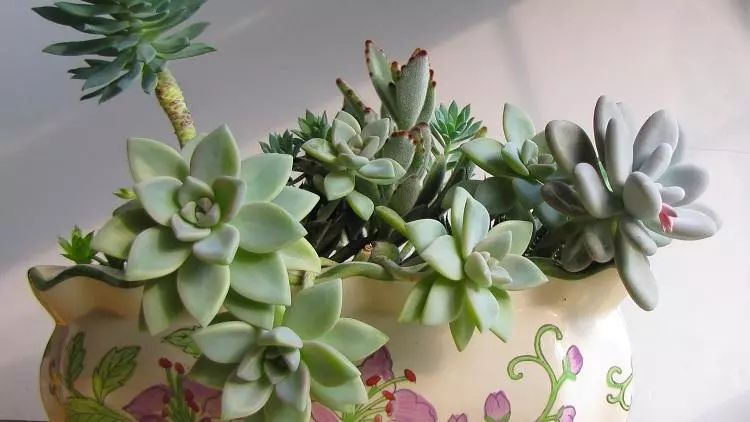
Fasciation in succulents is a mutation that occurs during natural growth, and it is a very normal abnormal phenomenon in succulents. Some succulents are prone to producing this kind of abnormal differentiation when stimulated by external factors, even developing horizontally into a line and eventually growing into a rather peculiar shape.
After some varieties of succulents are stimulated by various environmental factors (such as light, watering, climate, etc.), their apical growing points are prone to abnormal differentiation, forming many new growing points. These growing points then connect horizontally into a line, finally forming a cockscomb-shaped or fan-shaped succulent. In addition, variegation in succulents is also a common mutation phenomenon.
So what should we do if we want to maintain this fasciated form? Fasciation itself is actually a growth pattern in which succulents return to their primitive state. Therefore, in order to maintain the fasciated characteristics, besides removing the normally growing parts, it is also necessary to regularly place the succulent in a suitable environment. Moreover, succulents with fasciated changes also become more ornamental.
Of course, the propagation method for fasciated succulents is still cuttings. After cutting off the stem, insert it into soil and it will sprout and grow. However, it is best to cut off the fully fasciated part of the succulent so as to maintain the fasciated characteristics. In particular, some growing points that emerge later are very difficult to successfully fasciate.
Although fasciation noticeably changes the growth state of succulents, the cultivation method is still very simple.