Bonsai are quiet pets. One pot is simply not enough; bring out a few pots and show them off.
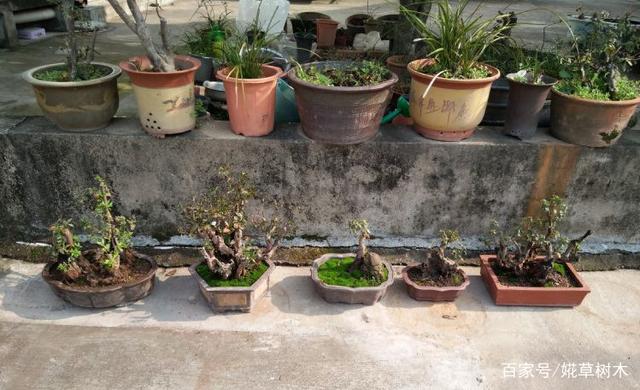
Bring out a few bonsai to show off. Bonsai are quiet "pets," and one pot is simply not enough! Let's talk about the experience of growing bonsai.
For thousands of years, bonsai has risen from a household landscape to an art form. In our ingrained impression, an ordinary bonsai easily costs tens of thousands of yuan, a high-end plaything that ordinary people dare not casually handle. "Bonsai are very expensive," "bonsai are very hard to care for," "bonsai are something only old people play with," "bonsai are something only rich people can afford to play with," "if you put one at home and accidentally knock it over, that's the end of it"... Narrow, one-sided perceptions like these have led many people to keep bonsai at a distance. And young people, with no time, no patience, and an eagerness for quick results, find it even harder to truly connect with this traditional art of bonsai.
Bonsai are expensive because the price lies in the overall spirit and charm. A bonsai is made up of plants and stones, a miniature landscape that reveals the large through the small. A good bonsai lets you gaze through that one small patch of indoor ground and see the truest beauty of the four seasons in nature. They go through spring, summer, autumn, and winter with the passage of time, can bloom and bear fruit, and continually wither yet continually grow back tenaciously.
The aesthetics of bonsai are also quite interesting. At first, people liked to shape bonsai into all kinds of strange forms to show uniqueness, losing the plants' most original state. But in recent years, the aesthetics of the bonsai world have also begun to trend toward naturalization, no longer pursuing deliberate beauty but the most original state, just like modern attitudes toward people's looks: surgically altered faces are increasingly unwelcome, while natural beauty is more sought after.
Bonsai are not remote from us at all. Young people can grow them too, and if you get good at it, there can be unexpected rewards. It is widely acknowledged that bonsai are expensive, but are all bonsai expensive? Of course not. Expensive bonsai mostly come from the hands of masters, and their expression and spirit can be called works of art. In Rugao Horticultural City, you can often see bonsai priced from three to five hundred to three to five thousand, which is a low price range in our understanding of bonsai prices. You can even buy a bonsai of your own for less than 100 yuan. So if your goal is not art collecting but cultivation and enriching your character, then expensive does not exist.
So what counts as a true bonsai? One with mountain stones and with soil and plants, able to grow and go dormant with the four seasons like all plants in nature, is a bonsai. A very good way to identify one is: long lifespan. Of course, this is under the premise that the bonsai is well cared for, and then a bonsai that can accompany you through decades or even be passed down through generations is a good bonsai.