Clematis 'Piilu' blooms so beautifully, and the care tips fellow gardeners asked for come down to just these few points
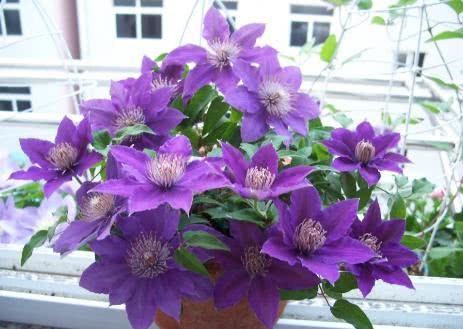
When I posted this photo of 'Piilu' in bloom, a lot of fellow gardeners asked me to "share my experience." I really don't know what unique experience I have. I just grow them the way I see others do it: seedlings, pots, soil, water and fertilizer, sunlight, ventilation, pests and diseases, and training the vines. This time I was asked again to "sum up my experience," and if I still don't give some explanation, I'd really be breaking my word.
First let me introduce my growing environment. My home has only one south-facing enclosed balcony. To grow flowers, I installed an external flower rack about 2 m long outside the balcony. The sunlight is very good. Ventilation can't compare with a terrace, but it's much better than inside the balcony. In summer it gets rained on; in the other seasons it almost never gets rain. Fellow gardeners can compare this with their own environment and treat the methods I'm about to describe accordingly.
One: Seedlings
I generally don't buy small bare-root seedlings. Small seedlings don't have enough resistance, and bare-root on top of that makes them hard to keep alive.
When the seedlings arrive, I take them out of the pot to look at the roots. Most small seedlings I buy have roots that have already grown to the bottom of the pot. If the roots aren't especially numerous and aren't coiled especially tightly, I'll let them settle for a while and then move them to a slightly larger pot. If what I bought is a several-year-old plant with more roots, when I take it out of the pot I may see the roots tangled together so tightly you can't even squeeze them apart. A seedling like that needs to be rinsed with water while the roots are untangled. This is a small seedling I just rinsed and untangled.
If roots that are coiled too tightly are planted directly into the soil, the inner roots can't absorb nutrients, and over time they rot. Even if they don't rot, the plant will grow weakly and produce few flowers.
Two: Pots
Pot material: either clay-burned pots or red terracotta pots. These two kinds of pots are breathable and not prone to root rot.
Pot size: I like to grow flowers in small pots, because I only have one external balcony flower rack, and I'm afraid the rack can't bear the weight of a large pot plus soil. Also, if the pot is too large, the wet-dry cycle is slow and root rot comes easily. These are three sizes of red terracotta pots I bought. The sizes are: 10×10, 15×13.5, 20×18.5,
For a seedling that has just been planted, I use a 10×10 pot, and only half a pot of soil, then add soil at the bottom of the pot as needed according to root growth. This pot of 'Utopia' is already a one-year-old seedling, and I still use a 10×10 pot, and only a little more than half a pot of soil. It can still grow for a while before I add more soil.
This 'Utopia' is in a 15×13.5 size flower pot.
This 'Worcester Beauty' was bought as a two-and-a-half-year-old seedling. When I bought it, I used a 15×13.5 size flower pot, and after half a year of growth I changed it to a 20×18.5 size flower pot.
This is when it first sprouted in spring
This is the bloom photo.
This pot of 'Piilu' uses a clay-burned pot. Excluding the rim, the diameter is about 20 cm, and the pot height is 18 cm.
This 'Leon' is about five years old, in a clay-burned pot, size 28×23.5. It's a bit too big. If I water just a little too often, the roots get damaged and part of the leaf edges turn black.
Three: Soil
For all the flowers I grow, I use only one kind of soil: coconut coir mixed with coal cinder. I never soak the coal cinder in water either. I crush dry coal cinder, soak the coconut coir open, mix the dry coal cinder with the wet coconut coir evenly. I don't pay attention to any particular ratio, just mix until it's loose and easy to turn over.
This isn't the ideal soil, but it's economical and practical. I plan to switch to peat soil plus coal cinder later, which should be better.
Four: Water
I water with tap water, water thoroughly after the soil dries out completely. Same old story.
Five: Fertilizer
Mudong organic nutrient solution, I've always used it. Not only for clematis, it can be used for others too. The nitrogen, phosphorus and potassium ratio is balanced. Huayonghua Zhidao, supplements the nutrients needed for flowering, just apply after dilution. Except when planting small seedlings and planting bare-root seedlings, when no fertilizer is added, in other situations it is applied mixed with water.
Six: Sunlight
Mine is a south-facing balcony, almost full sun, and direct light. The flowers bloom well. Actually I deserve no credit; it's all because the sunlight is good.
Seven: Ventilation
Open on three sides, against a wall on one side. It can't compare with a terrace, but it's better than inside the balcony
Eight: Pests and diseases
The main pests and diseases of clematis are leafminers, clematis wilt and southern blight
Leafminers break out in late spring and early summer. I only have three or four clematis, and I remove the insects by hand. When I see insects resting on the leaves, I gently carry the pot and flower inside the balcony, close the screen window properly, and pinch the small flies to death with my hand. Even if I don't pinch them, the small insects are phototactic and will fly onto the screen window, making them even easier to pinch to death.
Clematis wilt: when planting clematis, expose the roots slightly and don't let the stems touch the ground. This can effectively prevent clematis wilt.
Southern blight, the most destructive disease. If discovered in time, immediately pull out the seedling, wash the roots, disinfect them, throw away the soil, and also sterilize the pot with high temperature. It can still be saved. If discovered too late and the roots have all rotted, then there's no way to save it.
Nine: Training the vines and pruning
In winter, I always prune the clematis. If it can take hard pruning, I prune as hard as possible. If it can't take hard pruning, I still give it a simple trim. I take off the support, and coil the remaining stems onto the surface of the flower pot, because I'm a balcony grower and really can't stand having several supports propped up outside the balcony window in deep winter, with a few bare stems wrapped around the supports.
This clematis had its stems coiled in winter, and then in spring I was lazy again and didn't tie the stems back onto the support, so it grew like this. At first it grew pretty well, but later, when there were more leaves, the inside wasn't breathable, and many stems got clematis wilt, which caused a large number of flower buds to be cut off. Only about half the flower buds were left, and it still bloomed this much. Next time I won't be lazy again.