Hangtai Aquarium: Enjoy Fishkeeping - You Can Become a Master Without Rigidly Sticking to Formulas
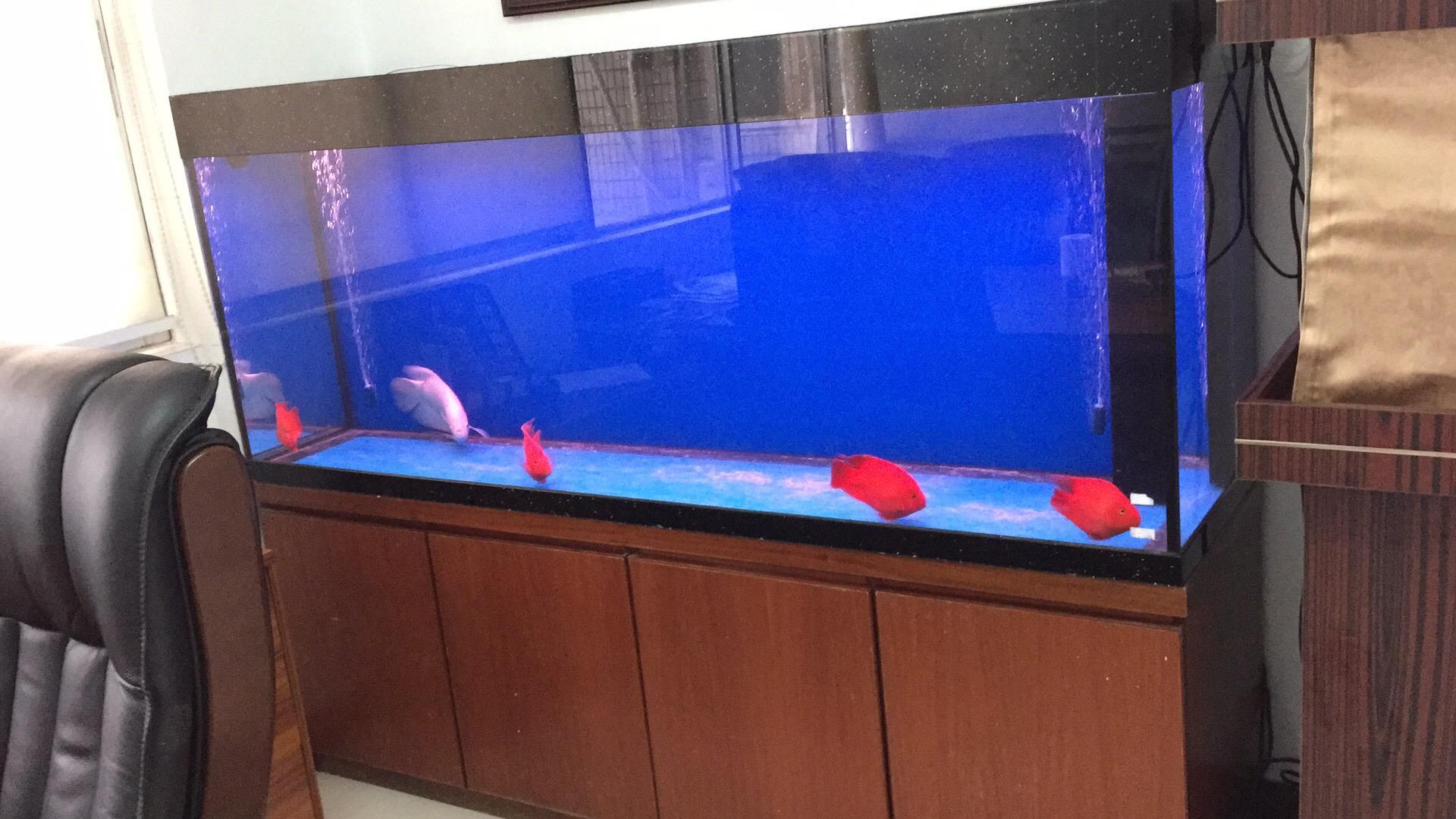
Many articles on biological filtration, though highly informative, are a bit too technical. Actually, the principle is quite simple - what is called biological filtration is just the concept of "aged water" that Chinese fishkeepers talk about. Aged water is the most suitable water for keeping fish.
So then, creating this kind of aged water requires certain methods; from a scientific perspective, aged water works because of the nitrifying bacteria in the water. How to produce and maintain nitrifying bacteria in the water - that is, the process of establishing and maintaining a biological system - in the terms of traditional Chinese fishkeeping, is the process of water going from new water to aged water through sun-curing, cycling with test fish, filtration and so on, and how to keep the aged water from reverting to clear water or even dead water.
Nitrifying bacteria need oxygen, water flow and so on, and maintaining aged water follows the same principle. Ever since the concept of biochemical filtration came along, nitrifying bacteria, activated carbon, ammonia-absorbing stones ... and all things related to biochemistry have emerged accordingly. These methods are certainly useful and scientific. But is nitrifying bacteria really that complicated?
Actually, with a powerful circulating filtration system, plus lighting and the necessary cycling with test fish, the water in the tank will naturally become aged water - there is no need to buy a whole pile of stuff for the sake of nitrifying bacteria. Chinese people have a longer history of fishkeeping than Westerners and keep fish very well; by also adopting some Western methods and equipment, you can keep fish even better. In other words, there is no need to be too superstitious about Western methods - combining local and Western approaches is better. And you do not need to spend that much money. Specifically, here are a few points:
1. Whether the pump's circulation strength can draw in waste
Pay attention to observing the circulation of water in the tank, and see whether fish feces can be sucked in by the pump. Adjust the pump's intake and the filter compartment's outlet to the optimal positions so that the feces are drawn in by the pump along with the water flow and enter the filter compartment. To make the pump work better, buy one slightly larger than usual - that is, for a 1.2 m tank, if a 30 W pump should be used, buy a 36 W one. Not leaving feces in the tank is the key. In addition, those keeping discus (Symphysodon) worry that the water flow is too strong and will buffet the fish, so you can point the outlet toward the tank wall, letting the water hit the wall inside the tank and then flow back to the pump's intake.
2. You can choose thicker filter cotton as a bacterial bed
This is quite sufficient. Relatively thick cotton can cultivate bacterial strains very well, so there is no need to spend more money buying bacterial strains, bacterial beds and so on. By comparison, sponge is better - more economical and practical. Filter cotton will fall apart after being washed a few times and needs to be replaced, while sponge lasts longer. Although each wash removes dirt and also washes away some nitrifying bacteria, enough nitrifying bacteria will remain to serve as seed. With the pump doing its job, plus the sponge both filtering and serving as a nitrifying bacterial bed, and with the tank walls and decorations in the tank all being good bacterial beds, aged water is thus produced. In addition, because the filter cotton is thicker, water may accumulate in the top-mounted filter compartment and overflow; just raise the retaining grid in the compartment a bit. Note: the sponge should be the fine, dense kind; a new one will have poorer permeability, but it will be fine after being used for a while.
3. Never worry about or rigidly cling to formulas
As for pH value, hardness and so on, handle them flexibly according to the situation. Fishkeeping is a form of entertainment; making it like academic research is too exhausting. The fish we keep are, for the vast majority, not wild - passed down generation after generation, they have basically adapted to the pH of our water. Buying fish from the south to keep in the north is, after all, only a minority case. As long as the water is kept in an aged state, the pH and hardness of this water will be no problem.
4. Regular water changes cannot be ignored
Even if the water is not cloudy, water changes are still necessary - 1/3 or 1/4 each time - but with what was said above, it does not need to be that frequent. Many friends have a misconception: they never change the water themselves, just topping up when the water gets low. Actually, this is much the same, because the purpose of changing water is to add new water to the tank to break down trace toxins in the aged water; if you can top up regularly, you can also skip the water-change step.
Summary of Experience
In the past, Chinese people kept fish in basins and used the siphon method, and aged water was maintained only for a short time. Nowadays, with pumps, the aged water in the tank is maintained for a long time. To keep the water in an aged state, the pump is crucial. The pump circulates the water, and the filter cotton or sponge both filters and acts as a bacterial bed. For a 1.2 m tank, using one external canister filter with sponge in both layers, with no ammonia-absorbing stones, bacterial strains or the like added at all, the sponge fully performs this role.
The longer the sponge is used, the more precious these two pieces of sponge become. Because they not only block dirt but also serve as a bacterial bed. Aged water (that is, the biochemical cycle) is thus produced and maintained. If, when setting up a new tank for fishkeeping, you can take two pieces of filter cotton from the filter compartment of an old tank, then establishing aged water will yield twice the result with half the effort.
Chinese people have a long history of fishkeeping, but unfortunately there are few scientific summaries; much experience is accumulated among the people, and when spoken it has no formulas and does not form written rules. In contrast, fishkeeping abroad emphasizes science - pH, nitrifying bacteria, biochemistry, physics and so on. Fishkeeping indeed requires this professional knowledge, but when it becomes too professional it turns into academic research, and its practicality and fun are greatly reduced. It makes beginners in fishkeeping fearful and even discouraged. I think it is better to combine traditional Chinese fishkeeping wisdom with scientific basis. It is more fun and more practical. Water changes, fish grow, and the water and fish in the tank change along with them; a few data points alone are far from a substitute for that.
My WeChat public account is guanshangyu-88. If you have anything unclear about ornamental fish keeping, you can contact me anytime!