What cultivation lessons for spring season wax gourd cannot be overlooked?
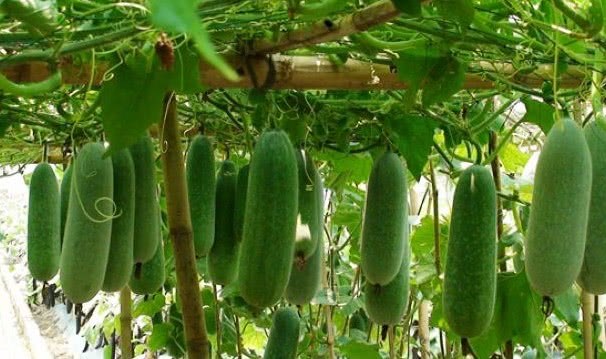
1: Introduction to wax gourd
The wax gourd, also known as hairy gourd or northern gourd, belongs to the Cucurbitaceae family as an annual climbing herbaceous plant and is a variety of winter melon. The wax gourd originated in southern China and thrives in places with higher temperatures and stronger sunlight. It is one of China's specialty vegetables. It has a long history of cultivation and a relatively large cultivation area throughout Lingnan. In Hainan, wax gourd cultivation also has a history of many years. The wax gourd has a relatively strong root system, but weaker than that of pumpkin. The stem is trailing with five ridges; lateral branches emerge from the axillary buds at the stem nodes, so it has strong branching ability. From the start of vine elongation, each stem node also has tendrils, and the tendrils branch; later there are flower buds, which differentiate into male or female flowers. The fruit is small, slightly longer and thicker than cucumber, 15-25 cm long and 4-10 cm in diameter; when mature, the skin is rough with stiff hairs, without a white waxy bloom, and the skin has fine hairs that prick the hand; it is relatively sensitive to nitrogen.
It also has effects such as clearing heat, relieving summer heat, detoxifying, promoting urination, and reducing swelling, making it an ideal vegetable for hot summers. In addition, it has a certain auxiliary effect on treating kidney disease, edema, diabetes, and so on. Therefore, in people's daily life, wax gourd is very popular whether stir-fried or used in soup.
Wax gourd has a cultivation history of more than 300 years in Guangzhou, China. It is relatively commonly planted in Guangdong, Guangxi, and Taiwan, China. It can be planted in spring, summer, and autumn, and is the largest among the cucurbit crops in area in Guangdong and Guangxi.
2: Cultivation lessons that cannot be overlooked
1. Set up trellises and guide vines, prune branches and press vines. When wax gourd seedlings grow to 12-15 leaves and the vines are 0.8-1 m long, insert bamboo stakes to build trellises and guide the vines, using an A-frame trellis method. When guiding the vines, straighten the stems and vines along the direction of the trellis, and hill soil to press the vines to encourage new roots. Wax gourd mainly sets fruit on the main vine. Before the main vine sets fruit, remove side vines in time. After the main vine sets fruit, select and retain side vines above the middle section to increase the number of fruits set on side vines later and increase production yield. 2. Reasonable topdressing. When planting wax gourd in spring, the early temperature is low. During the seedling stage, fertilizer and water should be controlled to inhibit growth and improve cold tolerance. Avoid excessive nitrogen fertilizer to prevent excessive vegetative growth. After thinning and transplanting, apply one topdressing in time, drenching with manure and urine water or compound fertilizer extract. Before vine guiding and during the flowering and fruiting period, apply heavy fertilizer, using compound fertilizer. After harvesting melons 2-3 times, apply topdressing once more, using compound fertilizer and potassium fertilizer. 3. Water management. Wax gourd likes moisture and fears waterlogging; especially during the flowering and fruiting period, water demand is relatively high, so it should be irrigated in a timely manner and the soil kept moist. After spring wax gourd seedlings emerge completely, generally water once at noon on sunny days. After flowering and fruiting, water once in the afternoon on sunny days. Stop watering 3-4 days before harvesting melons. After rain, pay attention to timely drainage to prevent water accumulation. 4. Pest and disease control. For damping-off disease control, spray with Husu Dajiangjun for disinfection and sterilization as prevention. For pest control, use insecticides in a timely manner.