Growing strawberries on the balcony: both edible and beautiful, don't just keep flowers and foliage plants
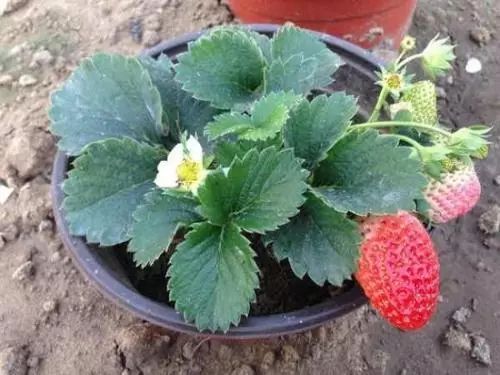
Always growing flowers and more flowers, everyone must be tired of it by now. For the same ornamental value, why not try some fruit? Not only can you look at it, you can also eat it - just thinking about it makes you happy. Today let's talk about growing strawberries on the balcony!
1. Sowing
Strawberry seeds are rather small, so sowing must be done carefully. It is best to fill the flower pot with sieved fine sandy loam mixed with a portion of finer humus soil, and sow in the pot. Before sowing, spray with water until thoroughly wet; after broadcasting the seeds, cover with about 0.5 cm of sieved fine soil, cover the pot with plastic film, and spray water daily with a fine-nozzle watering can to keep the soil moist. At a temperature of 25°C, seedlings will begin to emerge 15 days after sowing. When the seedlings grow 2 true leaves, divide them into separate pots; when they have 4 to 5 leaves, they can be moved into larger pots.
2. Seedling stage management
Watering: During the seedling stage, flood irrigation is not suitable; sprinkler irrigation can be used to meet the water supply. After the seedlings grow to 6 true leaves, small-scale flood irrigation can be used to prevent muddying the seedlings. Topdressing: When the young seedlings grow to 6 true leaves, the first topdressing can be applied, preferably with urea. For the first topdressing, the amount should be small; afterwards, apply fertilizer once every 20 to 30 days, and as the seedlings grow larger, the amount of fertilizer can be appropriately increased.
3. Pest control
If planting on a small scale, try not to use pesticides; you can spray with dishwashing detergent diluted in a large amount of water; you can also place some muskmelon rind, beer, and so on nearby to lure away snails and other soft-bodied crawling pests.
4. Keeping warm
In autumn, spread a layer of soil over the plants to prevent frost damage. After the soil freezes, you can spread another 3-4 inches of dry straw over the plants. By the following spring, when new leaves grow out, remove the dry straw. After the weather turns warm and stable, remove the covering soil on the surface of the plants. If you have a greenhouse at home, you can move the strawberries into the greenhouse, which is even better. Strawberries will also be more likely to bear fruit. After the strawberry fruiting period is over, you can move them out of the greenhouse and leave them outdoors to overwinter. In a way, if the strawberry plants experience some frost, it is even more beneficial for increasing yields the next year.
5. Harvest
Strawberry cultivation has a three-year cycle. In the first year you can only harvest very few strawberries; in the second year you will harvest a lot, but by the third year or after three years, strawberry yields will be relatively low, and at that point you can replace the plants.
Strawberries are very easy plants to cultivate and can be transplanted. Sometimes you may notice yellow leaves on the plants, but don't worry, just remove them. In winter, you can keep the yellow leaves until new leaves grow out the following spring, then remove the dead yellow leaves, and pay attention to watering, weeding, and pest control. You can also plant strawberries in plant bags, but be sure to water evenly, and prevent birds from pecking at the strawberries and pest damage. The soil in plant bags dries out very easily, so it needs to be checked frequently to keep the soil moist.