Active treatment of pre-cor pulmonale symptoms helps improve survival rates
The well-known cor pulmonale is the abbreviation of pulmonary heart disease in Western medicine. Traditional Chinese medicine, the traditional medicine of China, classifies pulmonary heart disease under the categories of "lung distension," "dyspnea," "cough," "phlegm-fluid retention," "palpitations," "edema," and so on. This clearly reflects the different symptoms appearing at each stage of cor pulmonale in Western medicine, such as cough, dyspnea, phlegm-fluid retention, palpitations, and edema, and moreover, the original symptoms do not disappear while new symptoms stack on top of them, heralding the day-by-day worsening of cor pulmonale.
Cor pulmonale as referred to in Western medicine is mostly a secondary disease, divided into two major categories: acute and chronic. Acute cor pulmonale refers to sudden embolism of the main trunk or main branches of the pulmonary artery, leading to obstruction of the pulmonary circulation, a sharp increase in pulmonary artery pressure, acute right ventricular dilation, and right ventricular failure; it is relatively rare in clinical practice. In the diagnosis and observation of Western medicine, it has been found that among chronic pulmonary heart disease cases, 80%-90% evolve as a complication from chronic bronchitis and bronchial asthma complicated by chronic obstructive emphysema that drags on without healing. In addition, pulmonary tuberculosis, bronchiectasis, silicosis, chest wall deformity, pleural thickening, chronic pulmonary interstitial fibrosis, and others, when unhealed for a long time, cause increased pulmonary circulatory resistance and aggravated right ventricular load, transforming into chronic cor pulmonale. Further progression of cor pulmonale will lead to the appearance of severe symptoms such as right ventricular hypertrophy and right heart failure, and acute exacerbation episodes are unavoidable.
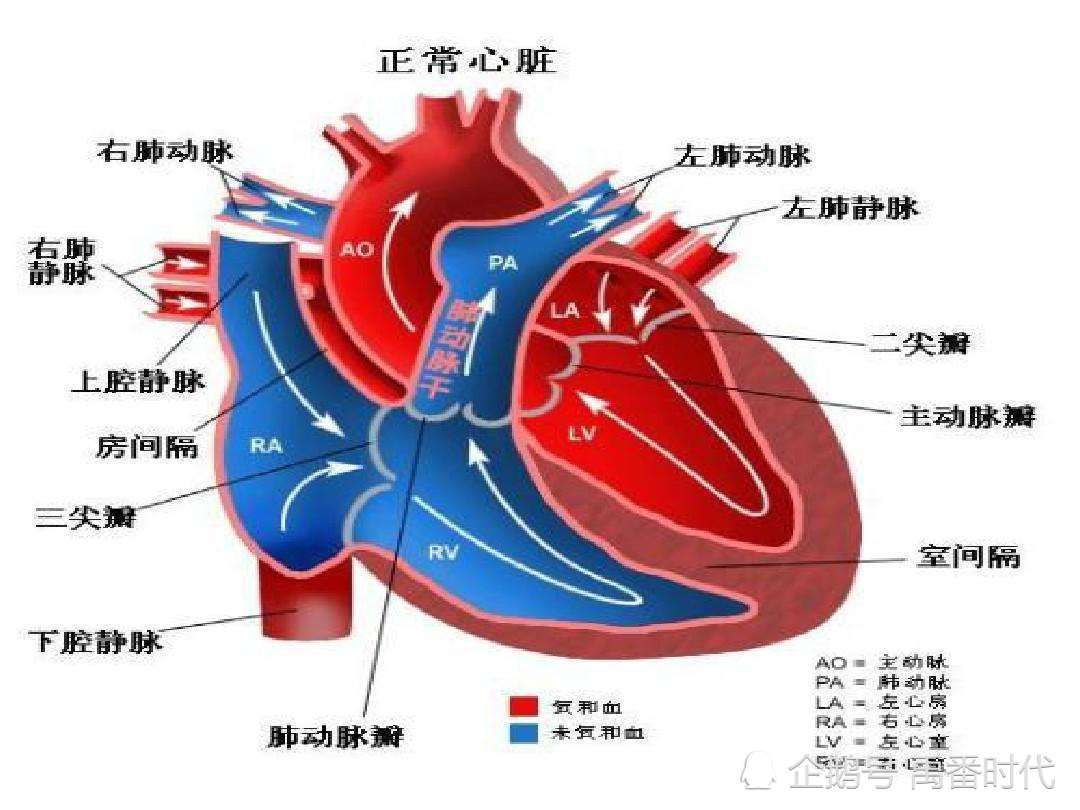
Normal heart
The pathological pathogenesis of cor pulmonale in TCM syndrome differentiation: cor pulmonale within the TCM categories of "lung distension," "dyspnea," "cough," "phlegm-fluid retention," "palpitations," "edema," and so on mostly refers to chronic pulmonary heart disease. It is the final outcome of various chest and lung diseases that remain unhealed for a long time. For pulmonary heart disease complicated by various chest and lung diseases that drag on without healing, the TCM medical pathogenesis manifests as phlegm-heat stagnating in the lung, because turbid phlegm congests the lung passages, leading to yang deficiency and rampant water-dampness. Therefore, cor pulmonale is mostly expressed in TCM as "lung distension," which first appeared in the Lingshu - Zhanglun: "Lung distension is marked by deficiency fullness with dyspnea and cough"; the Danxi Xinfa - Cough also says: "Lung distension with cough, or inability to sleep on either the left or right side, this is disease caused by phlegm mixed with blood stasis obstructing qi," and so on. All of these indicate that the TCM pathological pathogenesis of cor pulmonale is mainly caused by phlegm and blood stasis obstructing lung qi, so the Zhangshi Yitong - Lung Flaccidity says: "Lung distension is mostly an excess pattern."
Advanced stage of cor pulmonale
When various chronic chest and lung diseases drag on without healing, prolonged illness inevitably leads to aggravated obstruction of the lung passages, causing progression to cardiopulmonary functional compensation, entering the decompensation stage, and becoming pulmonary heart disease. This is the TCM medical principle that "prolonged illness inevitably leads to stasis, prolonged illness inevitably leads to deficiency," that is, root deficiency with branch excess. Therefore, TCM holds that the pathological pathogenesis of cor pulmonale is mainly lung qi deficiency leading to dual deficiency of qi and yin, further developing into yang deficiency, with insecure lung defense making one more susceptible to invasion by external pathogens such as wind, cold, summerheat, and dampness, with repeated episodes aggravating the condition and involving the viscera of the lung, spleen, heart, and kidney. "The spleen is the organ that generates phlegm, the lung is the organ that stores phlegm"; accumulated phlegm congesting the lung passages forms "phlegm clouding the heart orifices, yang deficiency with water flooding," and so on, making cor pulmonale a mixture of deficiency and excess that affect each other, bringing disadvantages to treatment.
Patients suffering from asthma, chronic bronchitis, and emphysema, as well as their family members and relatives, should promptly let the patient seize the opportunity for treatment and achieve the best possible recovery effect, so as to effectively prevent complicating cor pulmonale. Otherwise, with increasing age, declining self-resistance, and failure of multiple organs, cor pulmonale is very likely to complicate the condition, thereby increasing treatment difficulty and raising the mortality rate.