After a Christmas cactus blooms, give it one cut, and every pot you grow will thrive, blooming whenever you want
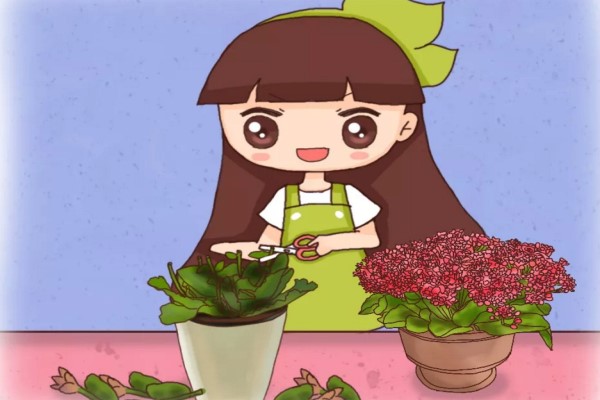
Give kalanchoe one cut after blooming, and it will burst into a full pot again in 1 month!
Many gardening friends' kalanchoes have basically finished blooming by now. At this point, just follow along and learn to make 1 cut, and new shoots will immediately appear, and it will quickly burst into a full pot again!
How do you prune a kalanchoe that has finished blooming?
1. Normally, if you notice your kalanchoe's color starting to darken, the flowers feeling a bit soft to the touch, and the flower stems starting to droop, it basically means it's time to prune.
2. When pruning, use disinfected scissors and cut starting from the position of the 2 pairs of leaves below the flower. As shown in the picture below, just prune from the position below the 2.
3. After pruning the kalanchoe, first place it in a cool, ventilated place to let the wound dry. After about 1 week, move it to a south-facing balcony to receive plenty of sunlight. During this period, water only after the surface of the potting soil turns white, to avoid root rot.
4. If you want the kalanchoe to sprout new branches as soon as possible, be sure to supplement with nitrogen fertilizer in time. You can bury 3-5 granules of compound fertilizer in the pot, or use homemade decomposed soybean fertilizer, okara fertilizer, etc., to let the kalanchoe grow more new branches and thus bloom more.
5. Never throw away the branches you cut off, because branches after blooming are especially full of nutrients. If you use them for cuttings, the rooting rate is very fast, and they can root in about 20 days!
Give a Christmas cactus one cut after blooming, and it will bloom as many times as you want!
Some gardening friends' Christmas cacti only bloom once and then never again, but other people's Christmas cacti can bloom 3-4 times a year. What's going on? Of course, it's because the post-bloom pruning was done properly!
How do you prune a Christmas cactus that has finished blooming?
1. If you find that your Christmas cactus's flowers have already begun to wilt to varying degrees, then quickly grab a pair of scissors and snip snip away, otherwise the flowers staying on the leaves will also consume unnecessary nutrients.
2. When using scissors to prune the spent flowers, cut at the middle node position of the 2nd-3rd leaf below the spent flower, that is, cut off the 2 leaves counting down from the spent flower. If the Christmas cactus's leaves are long enough, you can also cut a bit more. Basically, it's enough to leave only 6-8 nodes of leaves per branch.
3. After pruning the spent flowers, shorten the branches, cutting off all the old stems and overly dense stem nodes on the branches. The new branches that grow after pruning will be more tender green and sturdy, making the blooming more abundant!
4. After the Christmas cactus blooms, because it has consumed a large amount of nutrients, it has a short dormant period. At this time, we can take advantage of the dormant period to repot the Christmas cactus, cut off the old roots and weak roots, and then place enough base fertilizer at the bottom of the pot, such as soybean cake fertilizer, bone meal fertilizer, or homemade okara fertilizer.
5. During the dormant period, control water for the Christmas cactus and stop fertilizing. Wait until new buds appear on the stem nodes, then apply 1 time of dilute liquid fertilizer every half a month. When fertilizing, do not let it touch the stem nodes, so that the modified stems grow quickly. After flower buds appear, spray a 0.2% potassium dihydrogen phosphate solution, and the Christmas cactus will bloom again very soon!
6. Do not throw away the Christmas cactus leaves you pruned off. Prepare a nutrient soil made of peat soil and perlite at a 2:1 ratio, and use the Christmas cactus leaves for cuttings. They can root in about 10-20 days!
Give a camellia one cut after blooming, and it will bloom as many times as you want!
Because of different varieties, some gardening friends' camellias are still blooming, while some other gardening friends' camellias have basically finished blooming and are preparing to enter the spring shoot growth period. At this time, you must prune quickly!
How do you prune a camellia that has finished blooming?
1. After your camellia finishes blooming, be sure to prune it in time to avoid unnecessary nutrient consumption. After the camellia finishes blooming, it will leave a flower base on the branch. The post-bloom pruning we need to do is mainly to prune the 2 leaves at the tip below the flower base.
2. Cut off the 2 leaves at the tip of the flower base. If the tip leaves are staggered, then just prune 1 leaf. Because the camellia's growth has apical dominance, new shoots all sprout from the tip. Pruning this way can promote the growth of side branches, making more and more branches, and thus more and more flowers.
3. After pruning the spent flowers, do a renewal prune on the branches, cutting off old branches, weak branches, parallel branches, etc., to stimulate new branches and improve the camellia's vitality.
4. After pruning the camellia's spent flowers, before the spring shoots sprout, you can apply 1 time of compound fertilizer mainly based on nitrogen fertilizer or okara fertilizer, to supplement enough nutrients for the camellia to send out shoots. After the new buds sprout, spray 1 time of foliar fertilizer, which can make the spring buds sprout with vitality.
5. When the camellia's spring shoots grow to 10-20cm, you need to disbud the spring shoots, remove the tip buds, and leave 3-4 leaves, so that side branches can quickly emerge, making the camellia's overall plant shape look better.
6. Don't throw away the camellia branches you cut off either. After a little trimming, they can be directly inserted into the soil for cuttings. In spring, when the temperature is high and the temperature and humidity are sufficient, the camellia cuttings can root in about 10 days!
Give a cyclamen one cut after blooming, and it will immediately bloom a second round!
Many gardening friends' cyclamens bloom once during the New Year and then directly die, after which they are thrown straight into the trash. Actually, after a cyclamen blooms, as long as you take good care of it, reblooming is super easy!
How do you prune a cyclamen that has finished blooming?
1. For a cyclamen that has finished blooming, be sure to prune the spent flowers in time. Generally, prune from the bottom of the flower base, cutting off the entire flower stem.
2. Besides the spent flowers, all those dead branches and withered leaves should also be removed. If you don't want to use scissors, you can also just pull them off by hand.
3. The cyclamen's blooming consumed a large amount of nutrients from the tuber, so after post-bloom pruning, nutrients must be supplemented. You can bury 2-4 granules of compound fertilizer in the pot, or water with some homemade liquid fertilizer, so the tuber can accumulate nutrients.
4. In summer, when the weather is hot, the cyclamen will enter a dormant period, and the leaves will continuously wither. At this time, stop water and fertilizer, and place the pot in a cool, ventilated indoor place for care, so it can safely pass the summer.
5. Wait until autumn when the temperature drops, the cyclamen tuber will wake up from dormancy, begin to sprout new buds, grow flower buds, and thus successfully rebloom. It's just that a reblooming cyclamen will bloom a little less than the first time.
Give a rose one cut after blooming, and it will bloom from spring all the way to autumn!
Although many gardening friends' roses are still growing flower buds right now, some gardening friends have told me that in the warm south, quite a few roses' first flush is almost finished blooming. I'm really envious and jealous!
How do you prune a rose that has finished blooming?
1. After the rose's spring bloom ends, be sure to prune the spent spring flowers in time. Only this way can you avoid nutrient consumption, so the rose has enough nutrients to immediately carry out a second bloom.
2. When pruning, from above the rose's 3 leaves, at about 0.5cm, cut at a 45° angle, slanting inward, so the entire spent flower is cut off.
3. Blind branches and thin, weak branches on the rose branches should also be pruned in time, and those buds and leaves growing inward and downward should also be pruned at the same time, to promote ventilation and light inside the plant, enhance the rose's disease resistance, and also allow more nutrients to be supplied to the rose branches that bloom.
4. After the rose blooms, if you want it to sprout as soon as possible for a second bloom, you must supplement fertilizer in time. Things like decomposed rice water and compound fertilizer can all be used for roses, about 1 time every 10 days. After the rose sprouts flower buds, you can also water with some fishy water, which can make the roses bloom bigger and more numerous!
5. The rose branches you cut off, shorten them into small segments of about 7-10cm, and directly insert them into soil for cuttings, or place them in water for water propagation. They will basically root very quickly!
Regarding post-bloom pruning,
that's all I'm sharing today.
If you gardening friends still want to know about pruning for some flower,
why not leave me a message below!