How many of these luxurious spring flowers have you grown?
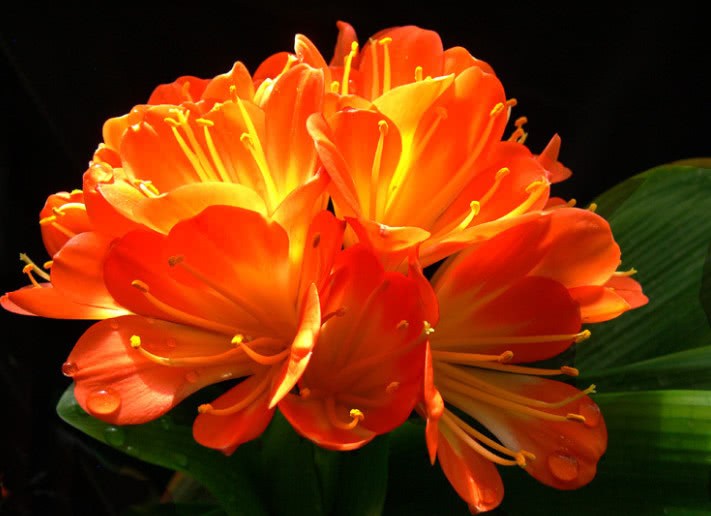
Spring has come around again, and stepping outside, you see grass growing and birds flying everywhere, a riot of colorful blooms. Spring is the best season for all things to grow, and the variety of plants that flower in this season is also the greatest of the whole year. Flower lovers who want to grow flowers at home, take note: how many of these luxurious spring flowers have you grown?
The editor wants to say that they all come recommended by a very experienced old gardener; though they look dazzling and colorful, they are actually fairly easy to grow and not at all delicate.
Clivia
Clivia, also known as large-flowered clivia, sword-leaf stone garlic, damulan, large-leaf stone garlic and so on, is a perennial herbaceous plant of the genus Clivia in the Amaryllidaceae family. Because ancient Chinese literati admired the aloof, leisurely and self-contented demeanor of orchid family plants, which has the air of a gentleman, it got its name. The roots of clivia are fleshy and fibrous, the leaf bases form a pseudobulb, the leaf shape resembles a sword, the leaves are large and alternate, and the leaf edges are entire. The inflorescence of clivia is umbellate and terminal, and each inflorescence can produce 7-30 small flowers, up to 40 when there are many. These small flowers have pedicels, the flowers are funnel-shaped, standing upright above the plant, and the color is orange-yellow or yellow. The flowering period of clivia is mainly in summer, and it can bloom throughout the year as long as climatic conditions permit. Clivia is suitable for planting in loam rich in humus, and it needs to be kept loose, breathable and well-draining. It likes a cool growing environment, and avoids high temperatures and strong light. The suitable growing temperature is 15-25 degrees, and in winter it must not go below 5 degrees. As for watering, in spring and summer it needs sufficient watering, at a moderate level, neither dry nor damp. As for fertilizing, although clivia is a fertilizer-loving plant, it should not be over-fertilized; during the normal growing season, mainly apply bone meal, fish meal, liquid fertilizer and so on.
Winter jasmine
Winter jasmine is a perennial herbaceous deciduous shrub of the genus Jasminum in the Oleaceae family, with other names including yingchun, golden belt, yellow jasmine and so on. As a potted plant it is about 30-100 cm tall, with slender, long branches that grow in an arching, drooping manner, while in the natural environment it can grow to more than 5 m. Its side branches are sturdy, four-angled, and green in color. The compound leaves are opposite, the leaflets ovate-elliptical, the leaf surface smooth, and the leaf edges entire. The flowers of winter jasmine are solitary in the leaf axils, the corolla is goblet-shaped, bright yellow in color, with 6 lobes at the tip or in a double-petaled form. The flowering period is from March to May in early spring. This is a flower variety native to China, with strong adaptability; it likes light, tolerates drought, cold and alkali, and fears waterlogging. It is best planted in loose, fertile sandy loam. Winter jasmine likes moisture, and during the growing season it needs sufficient watering; as for topdressing, applying 1-2 times a month of decomposed and diluted liquid fertilizer is enough. Note that during the flower bud differentiation period in July-August, some liquid fertilizer containing more phosphorus should be applied to encourage it to bloom.
Lilac
Lilac, also known as foreign lilac, is a perennial deciduous shrub or small tree of the genus Syringa in the Oleaceae family. It gets its name because its flower tube is slender and resembles an iron nail and carries a strong fragrance. The tree can reach 5 m in height, the bark is grayish-brown or gray, the twigs are relatively thick and sparsely covered with pores, the leaf shape is ovate to kidney-shaped, the leaf width is often greater than its length, dark green above and light green below. The inflorescence of lilac is paniculate and arranged upright, produced from lateral buds, nearly spherical or oblong in shape, the corolla purple, about 1-2 cm long, small and dense, with a rich fragrance and very high ornamental value. Lilac is also a plant variety with strong adaptability; it tolerates cold, drought and poor soil, and is suitable for planting in loose, well-draining neutral soil, avoiding acidic soil. The key points of cultivation are avoiding waterlogging and damp heat. As for light, it both likes light and tolerates partial shade; during the growing season, water appropriately according to the moisture level of the soil, and its fertilizer requirements are not high; during the growing season, topdress once every half month.
Wax begonia
Wax begonia, with other names including four-season begonia, clam-meat begonia and so on, is a perennial succulent herbaceous plant of the genus Begonia in the Begoniaceae family. Its roots are fibrous, the stem is upright and succulent, hairless on the surface, and the base is much branched and leafy. The leaves are ovate or broadly ovate, with serrated or eyelash-like edges. Both sides are glossy green, but the main veins on the leaves are usually slightly red. The flowers of wax begonia are usually pale red or tinged with white, and there are also orange-yellow, peach-red, pink and so on; several flowers cluster on the peduncle, the male flowers are larger, the female flowers smaller and with red wings. Its place of origin is Brazil. Its leaves are ovate and covered with fine down, the leaf margins have irregular notches, and the leaf color varies by variety, including green, red, brownish-green and so on, with a waxy luster. Wax begonia likes sunlight by nature, and in summer it needs to be placed in an area covered by scattered light; it tolerates shade slightly and likes warmth. It fears cold, likes slightly shady and moist soil, but fears heat and waterlogging, so in summer pay attention to shading and increasing ventilation. As for water and fertilizer, during the growing season, when the potting soil looks dry, appropriately replenish water; the principle is not to water when not dry, and to water thoroughly when watering. As for topdressing, in spring and autumn grasp the principle of light fertilizer applied frequently, mainly applying decomposed odorless organic dilute fertilizer water or inorganic fertilizer soaking liquid; during the flowering and bud stage, apply more phosphorus fertilizer.
These four flowers each have their own characteristics, and what they share is that spring is their flowering season; as long as you keep these few kinds of plants, full of luxury and with colorful, lively blooms, at home, it would be hard not to have a garden full of spring charm, and friends who want to start growing flowers this season can get ready to begin.