Are bonsai also divided into male and female? Let us take you into the mysteries behind them
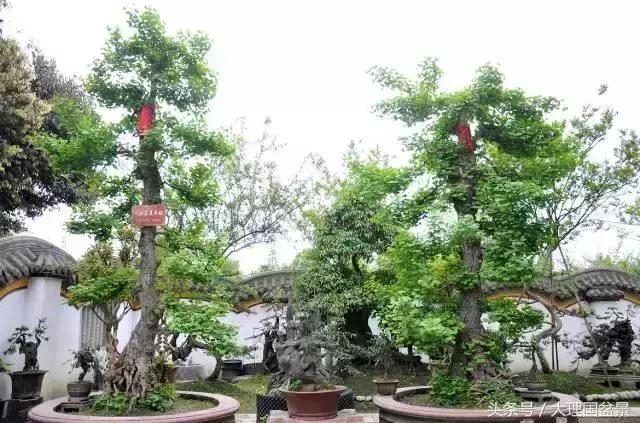
Every spring, the dazzling crabapple blossoms paint the sky red, and tourists flock to enjoy the flowers and view the bonsai, which has already become a major feature of Anlong Town. Whenever bonsai is mentioned, that pair of "Chinese Dragon" ancient ginkgo stumps hidden here stands out with particular brilliance and is especially eye-catching.
Rooted in Anlong, a male and female bonsai pair bound by a thousand-year love affair. "The two ancient ginkgo stumps, one male and one female, are about 4 m tall, the trunks have already split open, and the bark has carbonized into a fish-scale pattern. After verification and appraisal by multiple experts, this pair of ancient ginkgo stump bonsai has a tree age of roughly over 1000 years and a pot age of at least over 400 years, with extremely high collectible value." My questions were answered one by one by Leng Yuegang, standing director of the Sichuan Provincial Bonsai Association and cultural station chief of Anlong Town.
It is understood that although this pair of "Chinese Dragon" ancient ginkgo stumps has gone through hundreds and thousands of years of great changes and historical shifts, what has settled on them from bottom to top is a root base wrapped around "Han bricks" like dragon claws and bark like armor. The nine bends are still clearly visible and obvious at a glance, presenting the ancient posture of the "Hanwen Guai" unique to the Sichuan-style bonsai. Seen from afar, it is like a flying dragon soaring into the sky. The most magical part is that the ancient bends of the "Chinese Dragon" ginkgo are still "one male, one female," perfectly matching the Daoist philosophy of (yin and yang rooting in each other).
Today, this pair of thousand-year-old "kings of bonsai" is hidden in Hu Family Garden in Huijing Community, Anlong Town, still sprouting new buds and telling the outside world its own story about life.
Hu Jiuquan, owner of Hu Family Garden, said: "This is the oldest bonsai preserved in the village so far. Due to various reasons, the bonsai was once damaged to the point that only the trunk remained; but after more than 20 years of restoration efforts, it has now been restored to more than 85% of its original appearance."
One male and one female, all the more devoted because of Anlong's soil and water. When asked about the past history of this pair of ancient bonsai, I learned more secrets about how Anlong won the reputation of China's number one town of bonsai art. It is understood that the people of Anlong have revered horticulture since ancient times. On this land with a beautiful environment, fertile soil, and ample water, the carefully cultivated stumps and bonsai are simple and elegant, and the famous flowers and rare plants are graceful and refined. Hundreds of years ago, this village had already opened the curtain on making Sichuan-style bonsai, becoming a veritable bonsai village.
According to the "Anlong Township Gazetteer," Anlong had gardens such as "Fujia Tucheng" in the late Ming and early Qing dynasties, and by the Qianlong period of the Qing dynasty had horticultural and garden sites such as "Xiang Family Garden," "Hu Family Garden," and "Zhou Family Garden." In modern times, Anlong Town produced older-generation Sichuan-style bonsai masters represented by Yang Jie'an, Zhou Haiting, and Zhou Maohe, who once made bonsai for Chairman Zhu De. In the village, simple, rigorous, winding, and varied bonsai can be seen everywhere. Planted in pots and grown in the fields, each one with a unique shape, combining elegance, interest, and beauty, forms a distinctive picture with white walls and red tiles.
Nowadays, this pair of ancient ginkgo bends preserved in Anlong Town, shaped more than 400 years ago using the oldest method, "Hanwen Guai," is the best proof of the history of Anlong bonsai development. The soil and water of Anlong have also allowed this male and female bonsai pair to grow even more vigorously and become ever more devoted.
Establishing the benchmark value of Sichuan-style bonsai art. Recently, the news that "a buyer intended to pay more than 30 million yuan to purchase this pair of bonsai but was decisively refused by the garden owner on the grounds of passing on Sichuan-style craftsmanship" attracted people's attention.
As Leng Yuegang introduced: "More than 400 years ago, the Sichuan people at that time had already trained and shaped these two trees, which is why they have the Sichuan-style bonsai form of three bends and nine reverse turns. Therefore, these two bonsai are also called the 'ancestors of Sichuan-style bonsai.'"
It is understood that Sichuan-style bonsai originated in the Eastern Han dynasty and flourished in the Ming and Qing dynasties. It uses mountain grasses, trees, and stones to form landscapes and express aspirations, and by the late Qing and early Republic of China it had formed its style and school. With its unique technical system and styling style, it has become one of the five most influential schools in Chinese bonsai art.
Specifically, the production techniques of Sichuan-style bonsai are often divided into tree stump bonsai production techniques, mountain stone bonsai production techniques, and tree-and-stone combined bonsai production techniques. Tree stump bonsai production techniques excel at expressing the myriad postures of trees and have exquisite aesthetic value and ornamental effect; they often specialize in traditional training and shaping techniques, bending the trunk and side branches of trees into different shapes from a young age, with attention to three-dimensional spatial composition. The tree species used include golden bullet tree, Chaenomeles speciosa, Podocarpus macrophyllus, Serissa japonica, plum, pomegranate, bamboo, and others. The precious jade and gemstone tree stump bonsai currently stored in the "Chuxiu Palace" and "Yangxin Studio" of the Palace Museum in Beijing, China come from the Sichuan school. "These tree stump bonsai should all have been birthday tribute gifts sent to the emperor by Sichuan officials at the time."
Today, this pair of ancient bonsai speaks more of the profound connotations of the entire art of Sichuan-style bonsai in the identity of the ancestors of Sichuan-style bonsai, and also indirectly sets up a value benchmark for Sichuan-style bonsai art.