Bougainvillea: 4 steps to grow a big flower ball that blooms 365 days a year
1. Choosing the growing medium and watering!
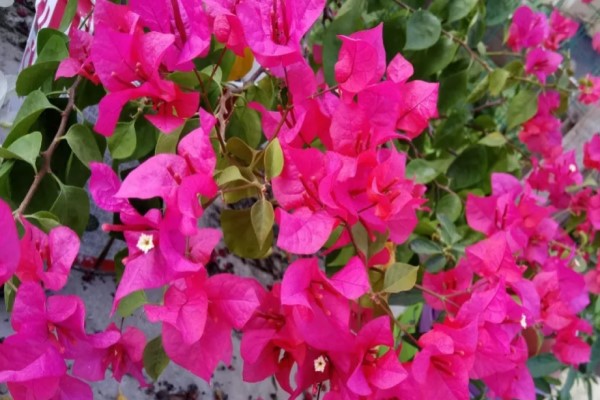
Observant flower lovers will notice that those bougainvilleas growing casually on street corners can shoot up several meters tall, blooming so heavily that you see flowers but no leaves! Yet the bougainvillea carefully tended at home blooms sparsely. How frustrating.
Bougainvilleas growing outdoors first of all get good sunlight, and secondly no one waters them, so they live on whatever the sky provides.
In fact, bougainvillea is different from other plants. It needs "water control" to promote flower bud differentiation. Bougainvilleas outdoors that nobody bothers with are often short of water, so they grow many more flower buds!
Bougainvillea flower buds:
Now that we know bougainvillea needs "water control" to bloom abundantly, what does that have to do with our choice of growing medium? If your medium has strong water-holding capacity, it won't dry out easily, and you won't be able to achieve the water-control effect. For the growing medium used to plant bougainvillea, you need to choose soil with good drainage.
Pengpeng uses garden soil plus river sand, roughly five parts garden soil to three parts river sand. River sand has good drainage capacity, and adding it can enhance drainage performance.
You can also use peat to grow it. Just mix the soil with five parts peat to two parts perlite. With this soil mix, the water-control effect is remarkable and it favors flower bud formation.
Next, let's talk about "water control." Water control means controlling the watering frequency. The principle is to inhibit vegetative growth in bougainvillea and shift it to reproductive growth.
For water control, in southern regions it generally means not watering for two or three days, until the bougainvillea's leaves are slightly dehydrated and wilted before watering. Because of regional differences, the length of water control varies, but remember to use "bougainvillea leaves showing slight wilting" as the standard for water control. After about a month of water control, you can find its flower buds at the tips of the branches.
2. Fertilizing and pruning!
Once you see bougainvillea flower buds, you can resume normal watering. At this point you can use a little fertilizer, which will promote flower bud growth. The fertilizer used at this time must not contain nitrogen, otherwise it will cause rampant growth of branches and leaves, diverting nutrients, and then all our previous efforts will have been wasted.
I recommend using monopotassium phosphate. It contains no nitrogen fertilizer and can promote root growth. Use this fertilizer once a week, sprayed on leaves at 1200 times dilution, until the bougainvillea's flowers have grown large, then stop using it.
Most bougainvillea flowers are borne on new branches. To make it bloom well, you also need to prune frequently. After the bougainvillea's flowers fade, cut back one third of the branches. This can break apical dominance, help nutrients flow back to the bud points, and prepare for the next explosive bloom.
After pruning following each bloom, fertilizer should be replenished promptly. I use the ordinary chemical fertilizer used for growing vegetables, sprinkling about ten or so granules on each pot.
Besides pruning after flowering, you should also pay attention to cutting off thin, weak branches at ordinary times. Thin, weak branches produce few flowers, and nutrients should be concentrated on the thick, strong branches.
That's what there is to know about bougainvillea.
Today's explanation ends here.
If there is anything else you flower lovers don't understand,
Hurry up and leave a message to consult Huahua!