Bougainvillea Potted Growing Methods and Precautions
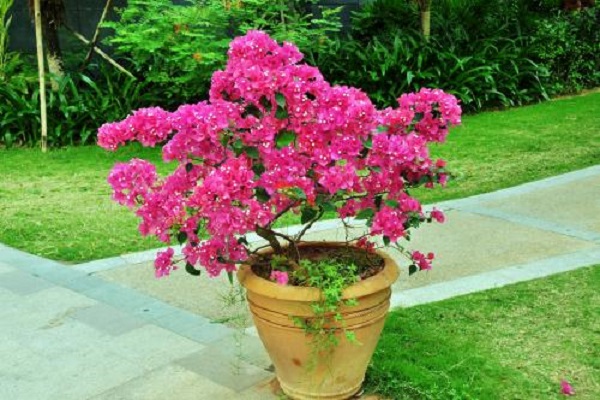
I. Growing Methods
1. Sunlight
It likes high temperatures and strong light, so place it in an area with abundant sunlight to help it grow better. Grown this way, the branches will have shorter nodes, the flowers will be more numerous, the colors will be deeper, and the flowering period will last longer.
2. Pruning
Its growing season is relatively long and its growth rate is fast, so prune and pinch it back often to keep it in a nice shape. Moreover, after pinching back, its branches will grow more and it will bloom more, because its flowers bloom at the tips of newly grown branches. Pruning is usually done in spring and summer; if you prune it after mid-August, it will affect its flowering, so be sure to pay attention to this.
3. Watering
From mid-August, reduce watering. After one watering, wait until the leaves droop before watering a second time, just enough so that it doesn't die of drought. Once flowers appear at its leaf axils, resume normal watering. Withholding water can help raise the concentration of its cell sap and help flower buds appear and grow.
4. Flower Fertilizer
If the timing and dosage of fertilizer are inappropriate, its leaves will grow very dense but it will have few flowers; in particular, it is very sensitive to urea, so be careful when adding urea. During hot weather with more rain, it easily grows leggy, so you should not add only urea; you can also use fertilizer composted from rotten leaves. In the early stage of flowering, you can add urea once to promote its growth.
5. Repotting
Generally, repotting in spring and autumn each year is best; if you are experienced enough, you can also repot it in other seasons. If repotting in spring or autumn, remove more of the old soil and old roots; if repotting in other seasons, leave a bit more old soil and old roots. For someone repotting for the first time, do not let its roots spread apart, as this lowers the risk.
II. Precautions
1. It is best to repot when the soil in the pot is relatively dry, because this makes it much easier to remove the original soil and old roots; do not repot right after watering.
2. When repotting, it is best to remove half or one third of the original soil, and do not let its root ball break apart, as this is safer; if you are inexperienced, do not clear away all the potting soil.