〈Petition〉Protect Students' Right to Breathe Safely - Install anti-smog equipment at all schools below senior high level in central and southern Taiwan, and immediately suspend outdoor classes when the hourly PM2.5 value exceeds 54 micrograms per cubic
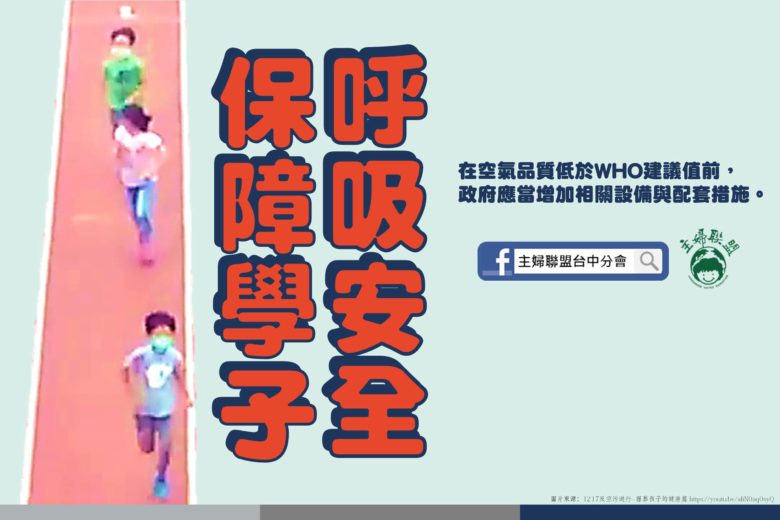
For the purpose of protecting students' right to breathe safely, our foundation has proposed on the Public Policy Participation Platform the initiative "Protect Students' Right to Breathe Safely - Install anti-smog equipment at all schools below senior high level in central and southern Taiwan, and immediately suspend outdoor classes when the hourly PM2.5 value exceeds 54 micrograms per cubic meter." If more than 5,000 endorsements can be gathered within 60 days (between February 2 and April 3), the responsible authorities (Ministry of Education, Ministry of Health and Welfare, and Environmental Protection Administration of the Executive Yuan) must respond to all demands in the proposal.
We sincerely invite everyone to visit the petition page (https://join.gov.tw/idea/detail/989005a8-6ff1-4c89-a7ac-5bff229816ef), click to endorse, and support "the government should increase relevant equipment and supporting measures before air quality falls below WHO recommended values" along with the three major demands put forward by our foundation!
Proposal content or suggested items
In addition to demanding that government agencies improve air quality as soon as possible, genuinely reduce air pollution, and propose concrete coal-reduction plans, the Taichung Chapter of the Homemakers United Foundation also believes that children's health and learning environment must be improved simultaneously! To this end, we advocate that before air quality falls below WHO recommended values (PM2.5 annual mean of 10 µg/m³, daily mean of 25 µg/m³), the government should increase measures and supporting arrangements to safeguard students' right to breathe safely, and we put forward three major demands:
1. Clearly implement "when the hourly PM2.5 concentration exceeds 54 µg/m³, schools immediately suspend outdoor classes"
On December 1, 2016, the Environmental Protection Administration changed the air quality index from PSI to AQI. The AQI index actually has a serious delay problem: PM2.5, PM10 and ozone are calculated using the most recent 12-hour or 8-hour moving averages, which cannot reflect the current deterioration of air quality, but instead present the historical air quality of the past. Moreover, only when PM2.5 exceeds 150 µg/m³ does it turn purple; the purple flags that used to frequently appear on campuses will no longer be seen. Even if PM2.5 breaks 100, it is only a red flag, and the red flag has effectively become the worst level of air quality!
We believe that the air quality monitoring station closest to the school and the campus's own PM2.5 micro-sensors should be the main basis. The above monitoring basis can reflect the current hourly monitoring value. When the hourly PM2.5 concentration exceeds 54 µg/m³ (air quality classification: 54 µg/m³ and above is a red alert) or the air quality index, schools should immediately suspend all kinds of outdoor activities, including physical education classes, sports meets, school fairs, etc., to safeguard students' health and avoid exposure to high concentrations of harmful air that could trigger short-, medium- and long-term health effects. The government and schools should recognize the health impact of air pollution on the people, and establish a comprehensive inspection mechanism, committing to protecting students' health based on the precautionary principle.
2. Use the air pollution fund or other budgets to subsidize schools in the heavily air-polluted areas of central and southern Taiwan (counties and cities south of Taichung) to install air boxes and other micro-monitoring devices indoors and outdoors, to strengthen real-time monitoring of PM2.5 air quality. Install anti-smog window screens, install air purifiers, or build air-dome gymnasiums and other anti-smog equipment, so that indoor air quality is also guaranteed.
3. Amend Article 18 of the Air Pollution Control Act and the Regulations Governing the Collection, Custody and Utilization of the Air Pollution Control Fund, adding a clear legal basis for using the air pollution fund to purchase anti-smog purification equipment for schools, so that each county and city can use this resource funding to improve indoor air quality in teaching spaces.
Benefits and impacts
The UNICEF report "Danger in the air" published in December 2017 clearly points out that air pollution will be a deadly killer threatening children's health in this century. This clearly shows the importance of protecting students' respiratory health.
If this proposal passes, one of the benefits is that approximately 1,513,818 students below senior high level and kindergarten children in nine counties and cities in Taiwan - Taichung, Nantou, Changhua, Yunlin, Chiayi, Tainan, Kaohsiung and Pingtung - will benefit, accounting for about 49% of Taiwan's school-age population (calculated based on the county and city student numbers for the 106th academic year downloaded from the Directorate-General of Budget, Accounting and Statistics on 107/2/1). It is absolutely the most forward-looking plan of 2018.
The second benefit is that the Air Pollution Control Fund (motorcycle license tax) that the government intends to collect from the public will be used effectively, rather than merely being used to subsidize factories in replacing boilers, which has continuously exploited people's health.
The impact of air pollution on health
Air pollution and fine particulate matter (PM2.5) are invisible killers of health, and developing children and adolescents are affected far more than adults. Domestic and international studies show:
Since 2015, the National Health Research Institutes, the Health Promotion Administration of the Ministry of Health and Welfare, and the Environmental Protection Administration of the Executive Yuan have jointly carried out a three-year "Impact of Fine Particulate Matter (PM2.5) on Public Health" project, tracking the lung function test results of 1,000 children and comparing them with local PM2.5 concentrations. It found that for every 6 micrograms per cubic meter increase in exposure, children's lung function decreases by 2%, affecting lung development and potentially increasing mortality.
UNICEF policy expert Nicholas Rees points out that the critical period for brain development in infants and young children is roughly within 1,000 days after birth, and because PM2.5 in the air is too small to be expelled by the human body, once it enters a child's body, it invades the walls of cerebral blood vessels, triggering neuroinflammation, hindering the child's neural development, and leading to severe deficiencies in verbal expression, IQ and memory later in life, making it even harder to realize learning ability and potential.
In December 2017, the latest British study published in the well-known international medical journal The Lancet found that walking slowly on a street with air pollution (PM2.5 concentration of 17 micrograms per cubic meter) is not only unbeneficial to the heart and lungs, but may even be harmful.
A study in the well-known medical journal BMC Pulmonary Medicine found that asthmatic children living beside busy main roads had an 80% increase in the probability of asthma attacks and pneumonia, and healthy children would also experience an increase in respiratory disease attacks due to air pollution.
Kuo Yu-liang, director of the National Institute of Environmental Health Sciences at the National Health Research Institutes, stated that the higher the PM2.5 exposure, the greater the health effects, and the World Health Organization (WHO) recommends that the annual average PM2.5 concentration should be below 10 micrograms per cubic meter. The research team estimated annual average values based on 2016 PM2.5 concentrations in each township and district, and found that most areas south of Taichung had PM2.5 concentrations higher than 24 micrograms per cubic meter, with some parts of Kaohsiung and Pingtung even higher than 30 micrograms per cubic meter, showing that PM2.5 pollution in central and southern Taiwan urgently needs to be controlled. Therefore, when air quality is poor in central and southern Taiwan, outdoor classes should be moved indoors.
Indoor air quality is also a focus of our attention. Taiwan was the second country in the world to regulate indoor air quality, but after the Indoor Air Quality Act came into effect in the 101st year of the Republic of China, classroom indoor air quality has not been valued or implemented as a result. The bodies of children and adolescents are still growing, and their ratio of breathing volume to body weight is 50% higher than that of adults. At present, because of outdoor air pollution, students have further reduced their time for outdoor activities. Originally, they already spent more than 80% of their time indoors, and the air pollution season coincides with autumn and winter, making the situation even worse. Moreover, children are more susceptible to the harm of indoor air pollution than adults. According to a WHO research report, 100,000 people worldwide die each year from asthma caused by indoor air pollution, of whom 35% are children.
We believe that only by both demanding a reduction of outdoor pollution sources and strengthening the improvement of indoor air quality can we truly and effectively protect students' health and safety. Both need to be taken equally seriously.