Grandpa mistakenly took the flower Grandma bought for cilantro, and no one could stop him
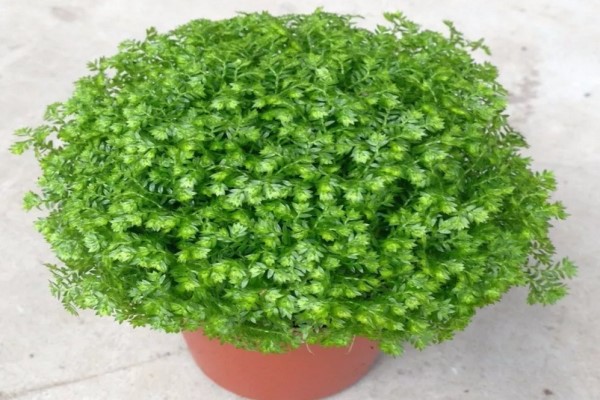
Green Globe, a master of pretending to be cilantro!
What this gardening friend's grandma bought was the potted flower below. At first glance, it really looks too much like cilantro, no wonder Grandpa got it wrong! It is called Green Globe. Its leaves are fine, dense and glossy green, with a luster just like a sapphire. It can even purify the air!
How to care for Green Globe?
1. Place it in a shady spot
Normally, place Green Globe in a shaded area, and do not let it be exposed to direct sunlight. If the light is too strong, the blue-green color will disappear and its looks will be greatly reduced!
2. Spray the leaves with water frequently
Besides watering every day, also spray the leaves with water frequently to maintain relatively high air humidity, so the leaves stay emerald green and elegant and grow more lushly! If it is placed in a dry, enclosed environment, it will turn into dried-out cilantro...
3. The temperature should not be lower than 5°C
The suitable growing temperature for Green Globe is around 20°C. If the temperature is lower than 5°C, it is not good for its growth. Although it is spring now, the outdoor temperature in some northern regions is still relatively low, so it is best to keep it indoors for care first.
4. Apply fertilizer once a month
Green Globe grows faster in loose, fertile sandy soil and leaf mold. Also remember to apply fertilizer once a month. Watering with homemade fruit-peel fertilizer liquid or cake fertilizer water is fine, making the leaves even more emerald green, growing rapidly to fill the pot, and the blue-green fluorescence it gives off will look even better!
Giant Allium and scallions are hard to tell apart
Next, Huahua will introduce a flower called Giant Allium. At first glance, it looks very similar to the scallions eaten every day, and when it blooms it is a round ball, just like a lollipop. Look at the pictures below and you will understand.
The first picture is Giant Allium, and the second picture is the scallion eaten at home. Did any gardening friends see it wrong? Giant Allium blooms in spring and summer. The large flower ball is as big as a child's head, and a single flower ball has more than 2,000 tiny flowers! It is not only beautiful but also a little expert at purifying the air!
How to care for Giant Allium?
1. Choose larger bulbs
Choose bulbs over 3 cm. The larger the bulb, the larger the flower ball it produces. One bulb only produces 1 flower. Gardening friends can buy more bulbs and plant them in groups; after blooming, it is very spectacular. Note that they are generally planted in mid-September, with soil covering the bulbs at least 5 cm, and they bloom from May to July.
2. Extremely cold-resistant, tolerates temperatures below minus 20°C
Giant Allium's cold resistance is excellent. It survives just fine even below minus 20°C. Gardening friends in the north can plant it with confidence.
3. Place it in a spot with plenty of sunlight
If gardening friends plan to plant it in the ground, plant it in a sunny position. If it is grown in a flowerpot indoors, place it on a south-facing indoor balcony. Only with sufficient light can it produce very beautiful large blue-purple flower balls!
4. Apply fertilizer once a month
Giant Allium likes fertilizer. Its flowering period is from May to June every year. It is spring now, so fertilize it once a month. Compound fertilizer, slow-release fertilizer, homemade fermented cake fertilizer, and so on are all fine, letting it grow rapidly and produce huge flower balls!
Ornamental Kale, is it a flower? Or a vegetable?
Isn't Ornamental Kale a vegetable? Why does it grow even more beautifully than a flower? Look at the Ornamental Kale in the pictures below. Its leaves are colorful and varied, with yellow, white, red, and so on, just like beautiful peony flowers, with excellent ornamental effect!
How to care for Ornamental Kale?
1. Sufficient light
If the light is insufficient, the leaf color of Ornamental Kale will become dull and lose its brilliant colors, so it should be planted in a sunny place.
2. Sufficient water
Keep the soil moist. Once it lacks water, the leaves will wither, and it will be difficult to restore them. So water sufficiently, but not too much, to prevent root rot.
3. Fertilize every month
Ornamental Kale likes fertilizer and needs sufficient nutrients to grow vigorously. When first planting, the base fertilizer should be sufficient. During the growth process, watering with homemade fertilizer liquid once a month is enough.
4. Control pests in time
Ornamental Kale is very easily eaten by cabbage white butterfly larvae. If the number of pests is relatively small at the beginning, you can eliminate them by hand. If there are too many pests, spray pesticide in time and let the insects die completely!
Have gardening friends ever grown these 3 kinds of flowers?
What other flowers do you know that look like vegetables?
Welcome to leave a message for Huahua!
Welcome to share it with friends!