Solar panels on Qigu's fish ponds: land rent up tenfold, is it a blessing or a curse for the fishing village?
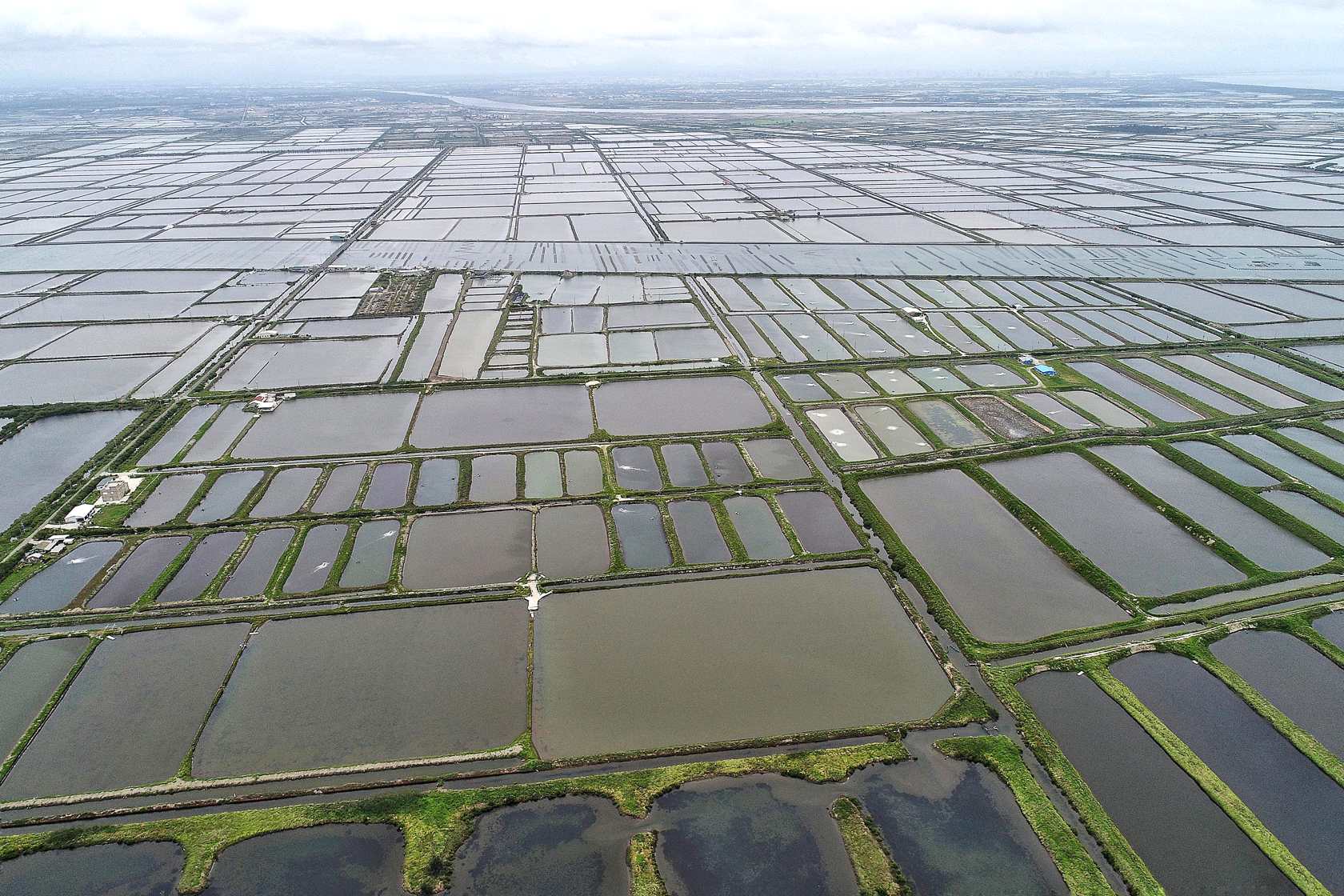
From downtown Tainan along Provincial Highway 17, about an hour's ride by bike brings you to the Qigu fish pond area of Tainan. As far as the eye can see, the water glitters, with fish ponds large and small interwoven, and because of the area's fresh seafood, quite a few live seafood restaurants are located there as well.
At four in the morning, before dawn, harvest workers go down into the fish ponds and dig out clam after clam with their bare hands; another group of workers then washes them and purges the sand, and yet other workers handle the packing and delivery. This is a group of people who make their living from the sea; from farming, harvesting, packing to shipping, they form a whole industry chain, laboring their entire lives on this boundary between water and land, diligent and earnest.
However, as the government rolls out its green energy policy, differing voices have begun to emerge in the traditional fishing village: should they pursue fishery-solar co-existence and install solar panels over the fish ponds? Or should they protect this sea, refusing to open up even a hint of pollution?
"Some landowners were tempted to sign when they saw the rent go up tenfold, and now they regret it and don't know what to do."
"Whether to lease private land is the landowner's right, not the right of all fishermen."
"Solar panels don't pollute? I won't believe it even if you kill me!"
"Here the solar power operators call the shots, and the fishermen have no role in it."

The contract is full of problems, and landowners regret it too late
The laws related to fishery-solar co-existence clearly have not yet passed, yet solar power operators have rushed in first, eager to enclose land. Beneath the seemingly generous profits, can the landowners who sign obtain the protection they deserve?
Yang Hui-chin explains that the land developer commissioned by Taiyen Green Energy first has the landowner sign a letter of authorization and consent, and after signing that, they sign the contract. "This contract is not as simple as you'd imagine; the deeper you dig, the more you find it's not what you thought, and none of the important matters are discussed." He gives an example: after the solar panels are installed, if the fish pond output falls below 70 percent and the license is revoked, or the construction company goes bankrupt, then as long as the operator cannot engage in solar power generation, it can stop paying rent to the landowner.
In addition, the contract also explicitly states that the superficies rights can be transferred. Yang Hui-chin points out directly, "What I sign with you, you want to transfer to a third party, and I have no say; it becomes the case that I have no lease with the third party, and that's a huge problem."
Furthermore, if the solar panels are damaged, they count as industrial waste. "How do you handle damaged panels? When the twenty years are up, how do you recycle these panels? Handling it could cost hundreds of millions, but the contract says nothing about it, which amounts to leaving it all for the landowner to deal with."
Some landowners slowly studied the matter and found something was off; the contract has many problems, but the letter of authorization and consent states that one must not use any pretext to refuse to sign, otherwise damages must be paid. "So even if landowners regret it, they dare not speak up, afraid of losing face, and they don't know what to do."
Taiyen Green Energy: If there are problems, please come straight to our door; signing will obtain the consent of the aquaculture farmers
Regarding doubts about the contract's contents, Kuo Cheng-wei explains that because a land developer was commissioned to do the integration, the developer, to protect its own rights, inserted the clause in the letter of authorization and consent requiring compensation if the landowner backs out and refuses to sign. "This part is a mess, and we can't control it, but once you step through Taiyen Green Energy's door and sign with Taiyen Green Energy, we will absolutely fulfill the promises and guarantees we give."
So if a landowner has signed the letter of authorization and consent, can they back out without paying compensation? "As long as there are problems, you are welcome to come to Taiyen Green Energy to find out." Kuo Cheng-wei points out that the final formal contract is still signed between the landowner and Taiyen Green Energy, and that they will take responsibility for resolving disputes. He also stresses that solar power operators must ensure the process does not pollute the land, otherwise they should pay corresponding compensation; and the contract also states that when the twenty years are up, the subsequent panel disposal issue is not simply left for the landowner to handle alone.
Then can the superficies rights be transferred to a third party without the landowner's consent? Kuo Cheng-wei explains that because the power companies are all subsidiaries and need time to raise funds, a reservation clause was included, with the parent company signing first and then transferring to the subsidiary, "but it will be transferred to the subsidiary with the consent of both parties."
Regarding fishermen's worry that they won't be able to rent land, Kuo Cheng-wei promises, "When signing the contract, in addition to the landowner, we will also obtain the consent of the aquaculture farmers." And after the land is consolidated, priority will be given to the original aquaculture farmers to rent, and they will be offered rent more favorable than the original NT$30,000 to NT$40,000 per hectare.
Council of Agriculture: Fisheries come first; demonstration zones will be set up before gradual opening
A landowner surnamed Wang who is also a fisherman says, "Whether to lease private land is the landowner's right, not the right of all fishermen." He believes that fishermen and landowners now forming an opposition benefits no one. Everyone worries about pollution and ecological change, and these issues must be comprehensively reviewed before opening up. "The key is that the whole process must be fair, reasonable and lawful, achieving a win-win for all."
Kuo Cheng-wei says that according to the 2,400 hectares of unfavorable farming areas announced by the Council of Agriculture, even if solar panels covered them all, other green energy solutions would still be needed to reach the 2025 green energy target; moreover, the fishing village industry is in decline and its scale is too small to compete with foreign countries. Therefore Taiyen Green Energy, as a platform between solar power operators and fishermen, hopes to establish a special fishery-solar co-existence zone, consolidate the aquaculture environment, and build up the fishermen's brand. "Fisheries must come first; solar power must not affect aquaculture."
However, Qigu is not a "declining fishing village." Both Yang Hui-chin and Chen Ying-yu stress that data show Qigu's clam output as a share of Taiwan's total has kept increasing. Since the fishing village is thriving, "it is rather unsuitable for another industry to come and affect this industry," Chen Ying-yu says.
Huang Shu-te, chairwoman of the board of the Green Advocates Green Energy Production Cooperative, says that future food production and solar energy must both be taken into account, and individual environmental differences must all be considered. In particular, she does not want solar panels installed in ecologically sensitive zones, such as intertidal zones, wetlands and estuary mouths; these habitats with rich biodiversity need a higher level of environmental assessment. In addition, the environmental difference assessments of these private lands are all entered by big corporate capital, and civic groups have no room to participate at all. "They just want the construction period to proceed quickly, with capital accumulation and circulation as the consideration, and ecology placed at the very end."
Facing all kinds of outside doubts, Lee Tui-chih promises to ensure the original aquaculture industry and achieve fishery-solar co-existence. "We are not just sitting in the office thinking; we already plan to ensure the original aquaculture practices through contract farming with fishermen. Otherwise, having only solar power without fisheries, leading to the hollowing out of the fishing village and the loss of its culture, is not something we would like to see either." Next they will complete trials and formulate relevant regulations, and he stresses that it is not an immediate full opening, but rather selecting demonstration zones first and opening up gradually.