Plant It Forward in Houston, USA | One Neighborhood, One Farm: Settling Refugees While Building a Community Food Security Network
Across the United States, programs that use agricultural activities to resettle refugees continue to increase. These refugee farms are mostly managed by teams formed by refugee resettlement agencies, churches, communities or businesses, while some farms are built from scratch by refugees and immigrants with nothing but their bare hands.
Plant It Forward, Making Houston a Food Oasis
In Houston, a major technology city known for aerospace and energy, it is hard to imagine that the food supply for the entire Greater Houston area's 6.3 million people depends almost entirely on imports from abroad or from other states, with fresh produce delivered directly from local farms making up only a tiny fraction. According to data from the Houston Food Bank, 18% of households and 25% of children have almost no access to fresh and nutritious food sources. In a suburban community in southwest Houston, residents rely on buying their daily food at gas stations.
Houston is also the most racially diverse city in the United States, resettling more refugees than any other American city. Among births recorded in 2013, 20% were to immigrant families. Although Houston has a dry climate, numerous oil refineries, vast sprawl and long commutes, its land costs are relatively low and housing and prices are affordable, which naturally attracts immigrants from all over the world. For this reason, Houston pays more attention to refugee and immigrant issues than other cities.
In 2010, a local software entrepreneur hoped to find a way to give back to the community and, together with the Catholic Church and community organizations, came up with the idea of Plant It Forward Farm (PIFF). Although Houston is a food desert, it also has plenty of space that can be used as urban farmland, so urban agriculture was seen as an opportunity to solve refugees' livelihood problems. The church therefore took the lead in leasing 3 acres of land and recruited refugees with agricultural backgrounds for a one-year training course in farming techniques and sales, using urban agriculture to help refugees transition into new lives, find meaningful work and achieve economic independence.
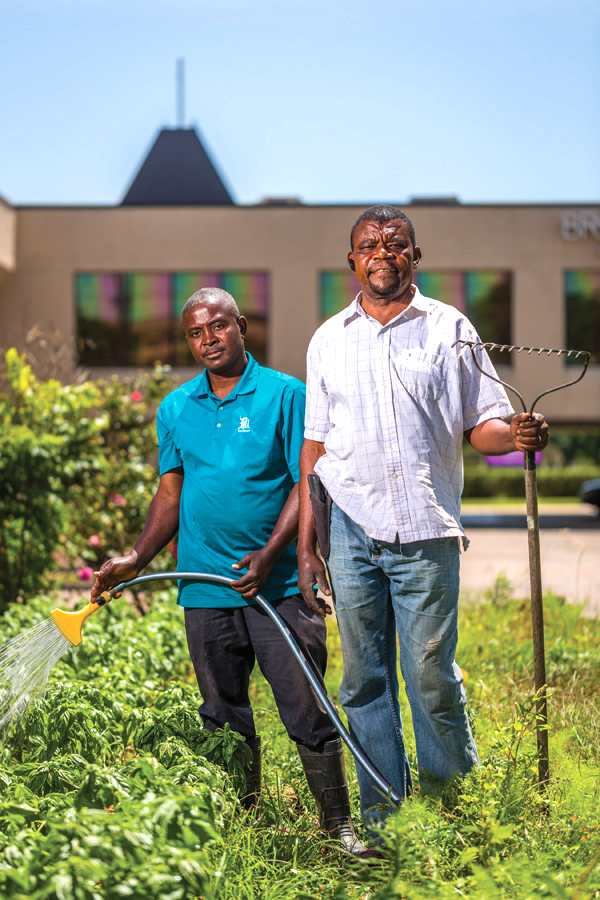

Every refugee carries their own ethnic culture and life history, and is forced into an entirely new place. Their psychological trauma also includes being ruthlessly severed from their homeland and from nature. For refugees, it is not only a matter of social adaptation, but also adaptation to geography and climate, as well as challenges to their existing beliefs, values, knowledge and skills, all of which affect their daily lives.
During migration, the importance of how refugees preserve their traditional culture and dietary characteristics has been proven. So, does urban agriculture have the same function? The answer is yes. Crops that preserve refugees' own cultures symbolize the continuation of multiculturalism, and urban farms can become exactly this kind of multicultural agro-ecological space, maintaining biodiversity, connecting refugees' own cultures with the culture of their new community in a meaningful way, and preserving knowledge of traditional foods. Preserving culture is also preserving natural ecosystems.
Therefore, using urban agriculture to resettle refugees provides vocational training or temporary job opportunities, and is even more a process of building a new life, an ongoing endeavor for life, reshaping the history and identity of a person and a family.