Artificial and monotonous mahogany plantations: where exactly lies the value of a forest?
Is the value of a forest really only its timber? Must forestry management be so narrow as to look only at how much high-priced timber it can produce? Can forestry management not calculate, on a macro level, the total economic benefit brought by the trees and everything beneath them? Ecology may be hard to quantify, but when planting native tree species that offer both timber value and nectar sources, has anyone calculated whether the economic income accumulated year after year would be lower than the profit from a single harvest decades later?
We hope for ecology to be protected, and we also hope for economic income. Talking about ecological conservation is such a vast scope that it is hard for people nowadays, who always demand numbers as proof, to accept. Why not start by keeping wild bees and planting forests as a trial? This also incorporates the maintenance of ecology, and we would no longer keep planting tree species that act as ecological barriers, such as mahogany!
Plantation areas are silent; native forests are ecologically rich
A few months ago I visited a famous wood-fired oven bakery in Hsinchu, and happened to chat with a group of veteran hikers about the joys of hiking. They sighed over what the reforestation of earlier years was even doing! Every time they walk into a plantation area, it is completely silent, not even birds go in; it does not feel like a forest at all. Native forest areas, by contrast, are ecologically rich, with not only a clamor of bird calls but all kinds of plants woven in between; walking through them is a true pleasure.
During the Spring Festival I returned to my hometown of Chungliao in Nantou. Taking advantage of the New Year holiday with nothing to do, I decided to hike a loop around the small hills near my home, especially since as a child I often heard classmates say they lived in "Ci Cong Lin" (Formosan prickly ash grove), but I had never been there! My mother said that in earlier years our family had a piece of land planted with bananas in "Banlu Liao," and my third uncle's marriage came about because he was looking for a helper to farm it. With my son accompanying me, I walked into those hills, not far away but never visited.
Along the way I saw a lychee grove long left uncultivated, every tree several decades old, but it was clear the owner no longer managed it, letting the lychee trees be covered by vines. Even so, I could still hear all kinds of bird calls and see butterflies fluttering before my eyes.
After passing through the lychee grove and crossing the ridge line, what came into view was a vast stretch of mahogany plantation, truly spectacular. Judging from the spacing of the trees, the landowner manages it with care. Walking inside was genuinely cool, with no sunlight at all; as I passed through, it was so quiet I could almost hear my own heartbeat. This made me think of what the hikers had said earlier, that plantations are like dead cities of ecology.
To me they feel like ecological barriers, just like firebreaks in a forest that keep fire from crossing over. When exotic species like mahogany are planted in large tracts on the mountains, could they act like firebreaks, making it impossible or unappealing for wild animals to cross? This kind of reforestation is like the large-scale planting of Norfolk Island pine in earlier years, only to find later that the results were not what had been imagined, a bit of wishful thinking. But it takes ten years to grow a tree, and to change, another ten years and then ten more.
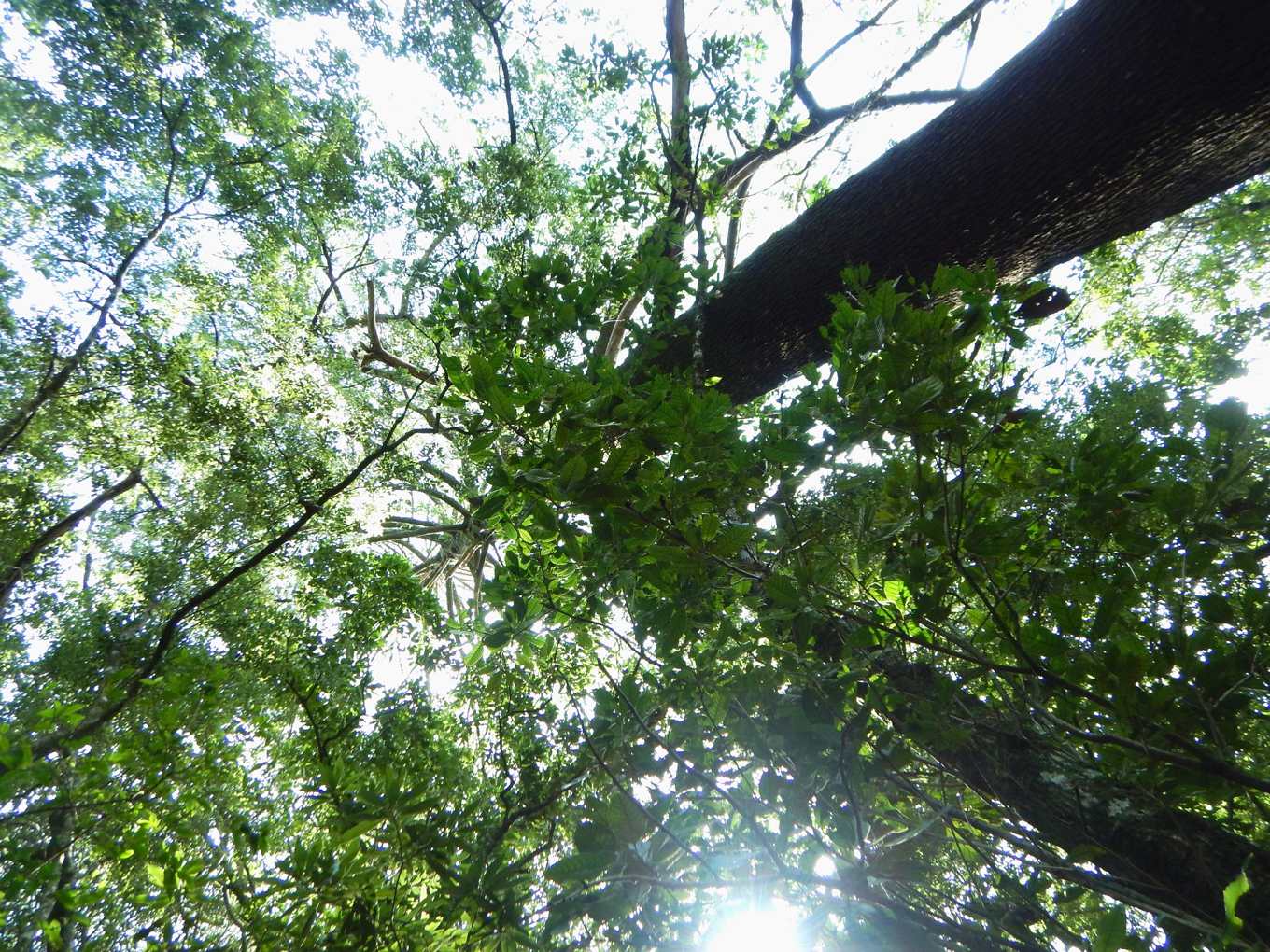
 Photography / Chang Yuan-ming
What is the value of a forest? Is it only the trees?
A few days ago, because I was moving bees for grazing, I went to an organic tea garden in Kara tribe, Fuxing District, Taoyuan City, and unexpectedly saw a patch of Taiwan cinnamon trees, which truly delighted me. After the 921 earthquake, when the government promoted reforestation, it once selected cinnamon, but unknowingly planted a great many Chinese cinnamon instead, and by the time the trees had grown into shade, turning back was already difficult. The Taiwan cinnamon trees had become treasures in many people's hearts. I had always wanted to see what a Taiwan cinnamon tree really looked like, and unexpectedly, when I came upon them, it was a whole large patch.
The owner of the organic tea garden not only farms organically but cares even more about ecology. I saw that the native forest beside the tea garden has a rich stand composition, and I mentioned that since the year before last, Taiwan's wild bees have suffered unprecedented disaster, with many beekeepers losing everything. My friend near Chunyang by Wushe said there are fewer bees in the wild too; a friend in the Xinxing tribe opposite Lala Mountain also said wild bees have decreased a lot! When he heard this, he said he could not feel at all that wild bees had decreased, and was constantly troubled by wild bees loving to land on him and disrupt his work.
I suddenly found myself thinking, what is the value of a forest? Is it only the value of the trees?
Whether the Forestry Bureau is reforesting on the mountains or encouraging reforestation, high-priced timber species have become the only choice: Taiwan incense cedar, camphor tree, Formosan Michelia, and the high-priced exotic species mahogany have also become one of the main options (it seems to have a high success rate, and many farmers choose it).
Are trees like Phoebe, cinnamon, and Fagaceae species (I have not studied this and do not know much, there should be many more) not worth promoting because their timber use is limited, and not worth planting even where the Forestry Bureau's land was originally native forest?
If we limit the value of a forest to the value of its timber alone, then we have probably also killed off ecology! The nuts produced by Fagaceae trees, for example, are food for many wild animals; without these important foods, there is less to live on, and ecology will be thrown out of balance as a result. Trees like Phoebe, cinnamon, and red lip (Adinandra), and even the duckfoot tree (Schefflera) that can only be used for matchsticks or clogs, are important nectar source plants for wild bees.
When we think about forestry policy only in terms of timber value, the ecology in the forest silently changes as well. Just as those hikers said, walking in a plantation is so quiet it makes one restless, because of the monotony: not only are the trees monotonous, but even wildflowers and wild grasses are gone, and bird calls and insect chirps have vanished. One always feels one is not walking in wilderness but in a silent dead zone, the only difference being that it still keeps a surface appearance of verdant green.
Find practices that combine ecology and forestry management: beekeeping and diverse use
About other ecological values I have not been involved with and dare not say much. But having recently taken up beekeeping (keeping Taiwan wild bees, which is a common name; the scientific name should be Chinese honeybee, the same species as in Japan and the mainland), I was startled to realize this is an industry that combines ecology and forestry management. In terms of reforestation, it happens that my late father participated using our own land, and my elder brother now inherited its management: on five fen of land quite a few camphor trees and mahogany were planted, more than fifteen years ago now, and they still have no value for felling and sale. Wait another ten years, and these five fen might sell for seven or eight million yuan, or ten million yuan. Spread evenly, that is at most 500,000 yuan of output value per year, and the key point is that in these twenty years there has been no income, only foolish waiting.
If nectar source plants could be planted, such as Phoebe (unrelated to Taiwan incense cedar) or Taiwan cinnamon, they should be able to support about twenty boxes of wild bees. If one box of wild bees produces twenty jin of wild honey a year, and one jin of wild honey sells for up to 1,800 yuan at market price, calculated at 1,500 yuan, that is 30,000 yuan, which comes to 600,000 yuan a year. Phoebe is not unusable as building material either; it is estimated that after fifteen years it can be rotationally harvested and replanted, still yielding timber income. The total income is still higher than planting high-priced timber, and there is income every year, enough to support a family.
I am not a forestry expert, nor an ecologist, and I have only just started beekeeping. Because I love running into the mountains, I saw and thought of these things, and I share my thoughts with everyone; there are sure to be mistakes in them, and the calculation model is even less precise.
But what I believe is that forestry management truly should no longer consider timber income as the only factor; with diversified thinking, a win-win model that combines ecology and economy can surely be found. The beekeeping I mention is only one of them; other intangible benefits related to species diversity are sometimes so great as to be hard to calculate. Perhaps high-priced timber and native trees such as Fagaceae could be encouraged to be planted together, interplanted at a ratio of one to one or one to two, so that there is both timber income and a richer ecology!