Soybean topic brims with gunpowder as agriculture sector and environmental groups trade jabs
"Soybeans shipped all the way from South America are processed into soybean salad oil, made into tofu for vegetarians to eat, and the leftover residue becomes animal feed." Reading this, I immediately felt my Dutch reading ability was lacking, that I had not understood the sentence. This was written by the chairman of the Belgian Dutch-speaking agricultural union, criticizing vegetarian groups for promoting "40 days without meat."
Soybeans from across the ocean: a killer of environmental sustainability?
EVA, located in Ghent, Belgium, continues and gives new meaning to the 40 days of fasting after the Christian carnival, and has gained responses from many civic groups and institutions. The union chairman, himself a dairy farmer, believes these hippie do-gooders have gone off the deep end, are contradicting themselves, and think themselves a cut above others by not eating pork and beef produced locally in Belgium, eating only those soybeans that come from afar. He states bluntly that diesel cargo ships severely pollute the environment, that soybeans are shipped in from thousands of miles away, and that soybeans are grown on farmland cleared by cutting down rainforest. He adds that fortunately Belgium's livestock and meat industry reuses the soybean residue left over from producing tofu, and that Belgium's high-quality meat is what truly preserves a sustainable environment.
Delicious locally produced steak relies on imported feed
A few days later, my colleague Herbal Tea and vegetarian groups joined forces and responded one after another to the agricultural chairman's opinion. Only then did I believe my Dutch reading ability was fine! First, they explained that the raw material of tofu is not salad oil; second, of those soybeans that come from felled rainforest and arrive by diesel container ship, 93% are used as animal feed. Furthermore, more than 50% of the animal feed for Belgium's livestock and meat industry relies on imports. So the "local" steak the chairman takes pride in on his plate is not "locally" produced; without a high proportion of imported feed, it would be impossible to supply the meat the public eats.
Only if Belgian people reduce the beef, pork, chicken and so on they eat every day, or even stop eating meat, would it be possible to eat animals that are local from feed to growth, from the inside out.
Herbal Tea also provided information that lets me eat tofu with peace of mind: soybeans from South America are genetically modified, and the EU does not permit the food industry to use genetically modified soybeans, so the tofu raw materials people buy come from the European continent, such as non-genetically-modified soybeans grown in France, Italy, Ukraine and Serbia.
Comparing Taiwan and Belgium: Taiwanese eat more meat
Herbal Tea said that only if Belgian people reduce the beef, pork, chicken and so on they eat every day, or even stop eating meat, would it be possible to eat animals that are local from feed to growth, from the inside out.
In Belgians' European way of eating, the main meal commonly features steak, pork chop and fish fillet. For a long time I subjectively assumed that Westerners' way of eating plated meals meant their total meat intake by weight must be greater than Taiwan's customary cooking methods using ground meat and shredded meat. But I was wrong!
According to Newsmarket, Taiwanese people eat 213.86 grams of meat per day, while nutritionists recommend 70 grams. Belgians eat an average of 111 grams of meat per day, while nutritionists recommend only 100 grams. If the two survey methods are the same, perhaps this proves my subjective bias correct (laughs). But in any case, modern diets really do make it easy to eat too much meat, which in turn affects animal farming and expands the industrialization of meat processing, creating pollution problems and resource allocation problems that we easily overlook.
Leafing through the catalogs of Taiwan's various supermarkets, or the super-popular barbecue restaurants, they compete to offer imported beef and pork from the United States, Australia, Japan and Spain. This offers a glimpse of how Taiwan's meat-loving consumers prefer imported goods, unlike European meat eaters who take pride in domestically produced hometown goods. Perhaps Taiwanese consumers are eager to avoid the food safety problems created by malicious merchants, and think less about the sustainable justice of the food production chain.
A first for Belgium's French-speaking region: the official agriculture ministry directly takes on vegetarian groups
The vegetarian promotion group Végétek, for the first time in the French-speaking Walloon region as well as Brussels, joined forces with the Dutch-speaking EVA to promote "40 days without meat." The official agriculture department swiftly set up the "I am a farmer" website, posted promotional materials in food supermarkets everywhere, promoted the benefits of eating local, and by the way smeared the vegetarian movement as being out of touch with the real world, eating only imported vegetarian fruits and vegetables, and called on the public not to believe it easily. The two sides went back and forth, neither yielding.
The French-speaking vegetarian group cleverly waged an online war, using a one-character difference from the name of the Walloon government's meat promotion website to launch a new website explaining how meat consumption harms the Earth's environmental resources. The agriculture minister was furious and threatened to sue the vegetarian group for stealing the domain name.
What if the milk foam in a rich latte were replaced with soy milk?
In contrast to the Dutch-speaking region, where vegetarianism has grown steadily and has a fixed supporter base, in Ghent, the city where the vegetarian movement was born, vegetarian groups used train car advertisements to encourage people to promote "not drinking milk" and instead drink plant-based milk products, such as soybean milk, almond milk and oat milk.
The dairy farming sector in the Dutch-speaking region was furious, pointing directly at these vegetarian activists as having gone off the deep end. However, vegetarians who are nutritionists or biology experts analyze the environmental pollution problems caused by humans drinking milk, as well as how calves, as soon as they are born, are forced to separate from the mother cow; female calves will grow up to become dairy cows, while male calves enter the slaughter and meat market. To increase milk production, the dairy industry raises dairy cows into super-sized dairy cows, and so on, all the mass-production problems after agricultural industrialization.
In other words, if a rich latte drink had no milk foam and instead had soybean milk foam, would you be willing? I have done various experiments making foam from plant protein milk products, and soybean milk can still produce thick foam, but of course the taste is different from milk.
The traditional agriculture sector expanded the battlefield to the European Court of Justice. The court ruled that plant-protein products such as soy milk, oat milk, soy yoghurt and soy cheese may not use the words milk, yoghurt, cheese or butter as product names, so as not to mislead consumers.
Open the fridge and look for the hidden soybeans
Europeans romantically imagine that the juicy, tender steak, roast chicken and so on on their plates come from a nearby pasture and can be called local agricultural products. According to a WWF survey, each European eats 61 kg of soybeans per year. Many people cannot believe it: they usually do not drink soy milk, do not eat tofu, and do not buy soybeans at all, so how could they eat more than 60 kg of soybeans?!
Because European animal foods rely on imported soybeans to make feed. For example, producing 100 grams of chicken breast requires an incredible 109 grams of soybean feed!
Our ancient Eastern dietary tradition, driven along by the Western concept of sustainable eating, has become a debate between environmental groups and the agriculture sector. For a descendant of soybeans, with tofu blood flowing in my veins, this is hard to associate with the human sustainability issues of people on the other side of the world.
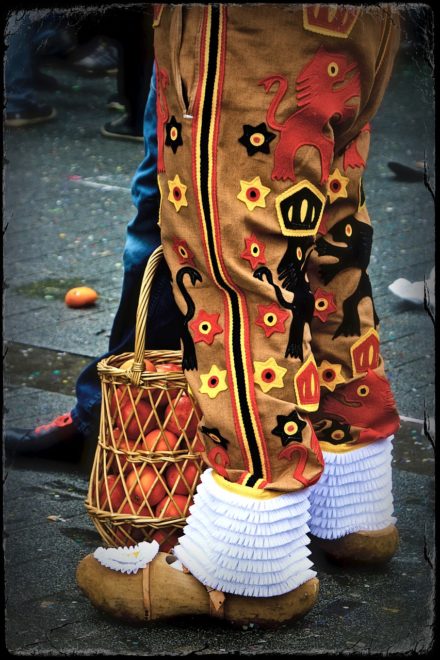
Note: The image is the Gilles costume of the La Louvière carnival in Belgium. Sourced from Pixabay.
"40 days without meat" was held for the first time in 2011, and in 2017 its seventh edition expanded to 100,000 Belgians participating. The organizers cited Germany's survey of Europeans' daily meat intake, pointing out that in recent years Belgians have reduced their meat eating much faster than other European countries, and therefore believed they had established in the public's awareness a link between meat consumption and the environment and climate, achieving the goal of reducing meat eating to ensure social sustainability, and so decided to bring it to a close.
A year ago, I finished writing this article, but left it sitting unpublished. Even though time flies and the meat-free fasting campaign has ended, the differences between the agriculture sector and those pursuing environmental sustainability, and Europeans' daily eating of hidden soybeans, remain unchanged.