Taipei's fruit and vegetable market closed for too long, farmers' associations across the country are unhappy, and the Council of Agriculture says it is unacceptable
The controversy caused by the closure of the Taipei fruit and vegetable auction market has continued to intensify, with many local farmers' associations voicing strong anger, saying that the flood of supply and price drops are not limited to the continuously harvested crops mentioned by the Meinong Farmers' Association.
Take Yilan white garlic as an example. Last year, the average auction price on February 27 was 64 yuan per kg, but by the same day this year it was 21 yuan per kg. Facing the farmers, farmers' association staff could not speak of their suffering and angrily said, "It is more than a threefold difference. When farmers come to the farmers' association to ask, we simply do not know how to open our mouths and report the vegetable prices to them." Some farmers' associations also said privately, "For Meinong, it was only that the prices were bad. On that day, a lot of the goods shipped out by our farmers' association were discarded as unusable. Some farmers are already threatening to bring reporters to the farmers' association for interviews!"
In order to quickly calm the controversy, the Council of Agriculture held a special meeting on March 1 to discuss the matter and issued a press release stating its position: "Regarding the Taipei fruit and vegetable wholesale market having two 3-day consecutive closures within a short period of 12 days, we express that this is unacceptable." When reporters sought further confirmation, Deputy Minister Chen Chi-chung also firmly said, "The Council of Agriculture cannot accept the Taipei City Government Market Administration Office having two 3-day market closures within 12 days. This is not directed at Taipei Agricultural Products Marketing Corporation."
Zhong Qinghui, director-general of the Meinong District Farmers' Association, who once served as a director of Taipei Agricultural Products Marketing Corporation (hereinafter referred to as "TAPMC"), said, "A market closure means the market is shut, and everyone has absolutely no opportunity to buy and sell agricultural products. Therefore, the arrangement of market closures must be especially cautious." He repeatedly stressed, "Once the market is closed, and especially closed for three consecutive days, the worst off are naturally the farmers who watch their crops grow every day but cannot ship them. Apart from worry and anger, farmers can do nothing!"
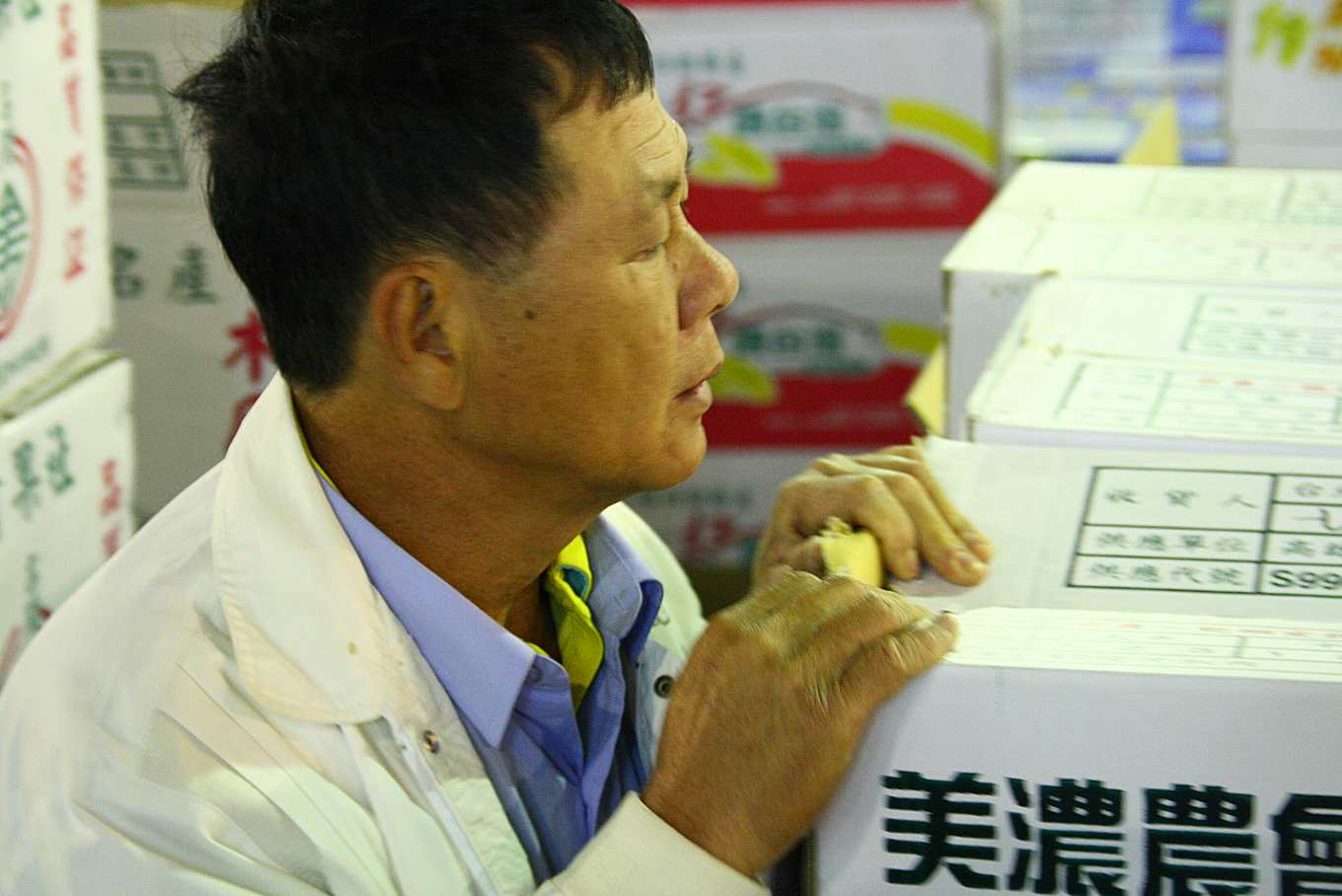

Farmers are helpless, market staff feel wronged; how should the process of deciding market closures be adjusted?
In the face of all this, including the bitterness and helplessness of farmers and the grievances of frontline market employees, is there really any way to avoid it? Can the mostly consensus-based market closure decision-making process be adjusted? Did TAPMC do a good job of emergency response that day?
Section Chief Gao Zhenxiang of Taipei City said that TAPMC should fulfill its function of rapid collection and distribution and provide the latest information to the central Council of Agriculture in a timely manner, so that relevant units can jointly promote early production-season adjustment and same-day cargo volume dispersal work. In response, Manager Wu Tianming of TAPMC said, "More than 120 employees and cadres in the auction team were on site auctioning desperately and also desperately urging consignees to enter. No one dared leave their work post."
Regarding the mostly consensus-based approach to market closure plans, Gao Zhenxiang believes that when consumers go to the market to buy things, they usually buy enough chicken, duck, fish, meat and all kinds of fruits and vegetables in one trip. If the market closures for fresh fruit, fish and livestock are not unified, it will affect buying sentiment in the end market. He said, "The overall benefit will differ. Trying to unify market closures would be a more appropriate approach." But Manager Wu Tianming of TAPMC strongly stated that if future decision-making on market closures is still based on unified closures, then as long as the issue involves a closure of more than two days, TAPMC will definitely insist on opposing it. "We must avoid such an impact happening again. Once was enough!"
Deputy Minister Chen Chi-chung of the Council of Agriculture emphasized that the characteristics of food crops are very different from those of fishery and livestock products. "At yesterday's (the 1st) emergency meeting between the Taipei City Government, the Agriculture and Food Agency and TAPMC, I strongly stated that in the future it absolutely must not happen again that the market is closed for three consecutive days or more. This has too great an impact on farmers." In addition, because this year's Mid-Autumn Festival also has a 3-day consecutive holiday from September 24 to September 26, Chen Chi-chung said he had specifically instructed at the meeting that the number of market closure days for the Mid-Autumn Festival must be adjusted earlier and asked the units attending the meeting to take it back for discussion.
Zhong Qinghui, director-general of the Meinong Farmers' Association, emphasized that the Taipei City Government Market Administration Office must take both consumers and production areas into account. It cannot say that a majority consensus decision is necessarily right; it must consider the "greatest public interest." He believes that apart from the Spring Festival, market closures should try not to exceed two days, because once the market is closed for three days or more, the freshness of the fruits and vegetables consumers buy will definitely not be very good, while producers will also face the dilemma of having goods but being unable to ship them. He further explained, "A market closure means the market is shut. Once the door is closed, no one has a chance. Think about it: if the auction market stays open, farmers can decide for themselves whether to ship, and consignees can also decide whether to enter. But once the market is closed, no one has any choice."
Zhong Qinghui repeatedly said, "Open the doors of the fruit and vegetable market, and volume and prices will naturally return to the supply-and-demand mechanism and find a balance point."