Causes and Solutions for Blackening Leaves on Variegated Schefflera
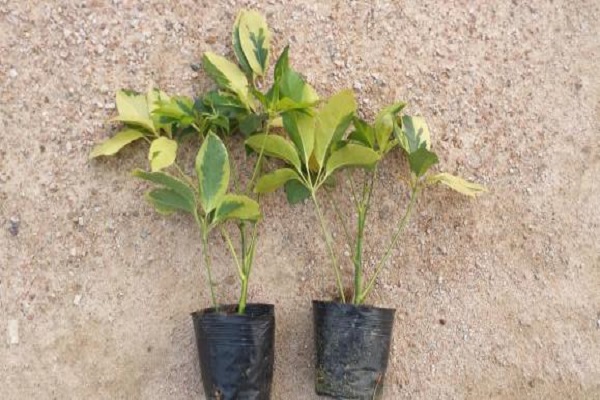
I. Causes and Solutions
1. Light
The blackening may be due to insufficient light during its growth. The intensity of sunlight affects the color of the leaves; when it is stronger, the leaves are emerald green, and when it is weaker, the leaf color is pale. If it lacks light for a long time, the leaves will turn black.
Solution: In this case, it needs to be moved to a location with good light.
2. Water
The blackening may also be because too much water was given. Too much water may cause waterlogging in the potting soil, damaging its root system and preventing it from properly absorbing nutrients from the soil, which can also cause its leaves to turn black.
Solution: Control the amount of water; do not give too much. It is better to water several times than to have too much waterlogging in the soil.
3. Air circulation
The blackening may also be because there is not enough fresh air. Some people keep it in a room but do not place it in a windy, ventilated spot. Moreover, air conditioning is generally used in summer and winter. If it faces the air conditioner directly, it receives very dry air, which can also affect the leaves and cause them to turn black.
Solution: Change its location and give it a growing environment with smooth air circulation.
II. Daily Care
1. Usually do not put it in a room where it cannot see sunlight. Place it by a sunny window, and the air must also circulate. The potting soil should have good drainage and be fertile and breathable. If it is potted, a soil made by mixing peat and rotten leaves can be used to grow it.
2. It likes warm and humid areas and grows quickly. It should be kept at a temperature of 20 to 30 degrees, and in winter it should not go below 5°C. If it is below zero degrees, it will freeze and drop leaves. If it is lucky enough that the stem is not damaged, it will grow leaves again the following year.
3. If the humidity is high and there is enough water, it will have dense branches and leaves, but there should not be too much, otherwise the roots will rot. This is a common symptom of many plants. If there is a lack of water or the water is unbalanced, it will also drop leaves. In the north, it will go dormant in winter and temporarily stop growing. In summer, when it is too hot, its growth is also poor. Only spring and autumn are best for its growth, so water must be controlled in these two seasons.