Is the "thick-skinned plant" the same as a succulent? One article makes the relationship between the two clear
1. The connection between the two
Strictly speaking, the "thick-skinned plant" belongs to one type of "succulent." Besides this one plant, "succulents" also include many other types, such as "Huangli" (Sedum adolphi), "Qingmeiren" (Pachyphytum), "living stones" (Lithops), "pencil cactus" (Euphorbia tirucalli), and so on. In addition, all kinds of cacti also belong to a category within the broad scope of "succulents." Therefore, we can draw the conclusion that the scope of "succulents" is much broader, and includes the former category of plants.
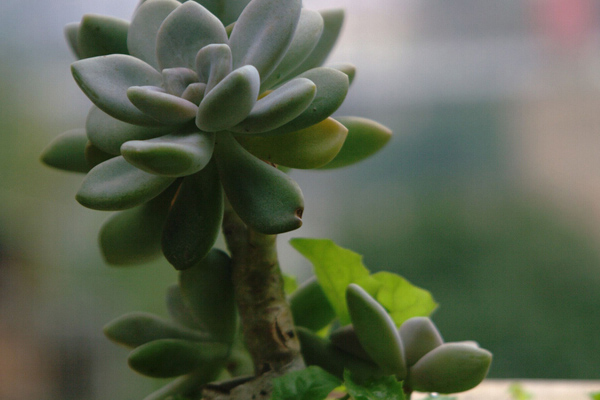
In addition, regarding the "thick-skinned plant," different regions have different explanations. Some regions consider it to refer to the "jade plant" (Crassula ovata); some places consider it to refer to "Graptopetalum paraguayense" and "Pachyphytum oviferum." However, no matter which region's explanation it is, they are all considered to belong to succulents. It is just that, because their leaves are very thick and their vitality is extremely tenacious, people habitually call them "thick-skinned plants."
2. Classification
Based on the explanations from different regions, what we now call the "thick-skinned plant" mainly includes the following two types:
(1) Pachyphytum oviferum: also called "Dongmeiren," with slightly pointed leaves. It is usually blue, and if the light is good, it may turn pale pink. In addition, the surface of its leaves also has a white powder, very beautiful.
(2) Jade plant (Crassula ovata): this plant is relatively tall, able to reach one to three meters. From late spring to early summer, it blooms with white or pale pink flowers, charming little blossoms. The leaves are ovate, grayish-green, and fleshy.