Where does the arsenic in rice come from? Chen Hsiu-Ling and Lee Ching-Chang discuss the safety of Taiwan rice
Text / Chen Hsiu-Ling, Professor at the Institute of Food Safety, Health and Risk Management, National Cheng Kung University, and Lee Ching-Chang, Distinguished Professor at the Department of Industrial Hygiene and Institute of Environmental and Occupational Health, National Cheng Kung University
With the development of industrialization, pollutants from environmental sources are released into the air, water and soil, threatening agriculture and food safety. Do these pollutants affect the production quality and prices of local agriculture and livestock industries? Will the crops grown be contaminated by heavy metals and accumulate in the bodies of those who eat them, thereby affecting health? For the people of Taiwan, whose diet is based mainly on rice, these have always been issues of great concern.
This article is reprinted from the ILSI Taiwan column, written by Professor Chen Hsiu-Ling of the Institute of Food Safety, Health and Risk Management at National Cheng Kung University and Distinguished Professor Lee Ching-Chang of the Department of Industrial Hygiene and Institute of Environmental and Occupational Health at National Cheng Kung University. It introduces readers to the chronically toxic substance "arsenic," cites domestic and international data on arsenic levels in rice to point out the distribution characteristics of arsenic in rice grains, and finally discusses the safety of rice consumption by people in Taiwan and how to reduce the risk of arsenic exposure in the diet.
What is "arsenic"?
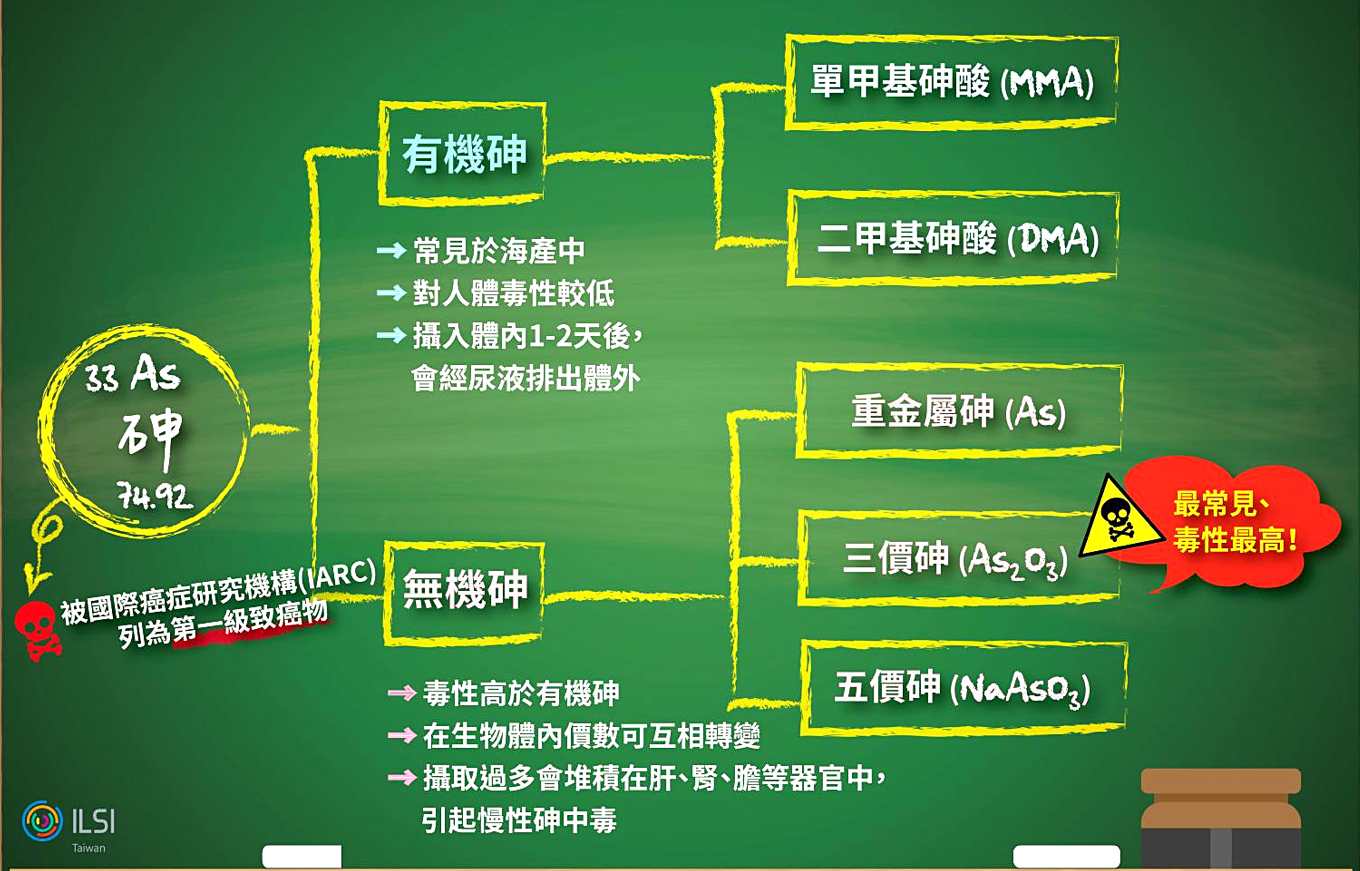
Arsenic is a chronically toxic substance. When it is present in excess in groundwater, it not only makes the groundwater undrinkable but also has adverse effects on the environment and ecology. Arsenic can enter the human body through inhalation, ingestion and skin absorption and accumulate there. If excessive arsenic compounds cannot be excreted through metabolism and accumulate in an organism, they will cause harm to that organism. In 1987, the International Agency for Research on Cancer (IARC) already listed arsenic and inorganic arsenic as confirmed human carcinogens (Group 1), confirming that arsenic exposure is closely linked to bladder cancer, skin cancer and kidney cancer.
Arsenic can be divided into two major types: organic arsenic and inorganic arsenic. Organic arsenic is usually found mostly in seafood and has relatively low toxicity to the human body; about 1 to 2 days after ingestion, it is metabolized by the kidneys and excreted in urine. Its most common forms are "dimethylarsinic acid (DMA)" and "monomethylarsonic acid (MMA)." Inorganic arsenic can be divided into three forms: "heavy metal arsenic (As)," "trivalent arsenic (As2O3)" and "pentavalent arsenic (NaAsO3)." In organisms, the valence state of arsenic can interconvert, and among these, trivalent arsenic (As2O3) is the most common and the most toxic. Long-term intake of too much inorganic arsenic will accumulate in organs such as the liver, kidneys and gallbladder, causing chronic arsenic poisoning (Figure 1).
The dose of arsenic ingested from rice by people in Taiwan is below international standards
Rice is the staple food of people in Taiwan. According to statistical data, people in Taiwan aged 19-62 eat an average of 62 kg of white rice per year, while the average annual consumption across the whole population is 47.5 kg of white rice, far higher than that of other types of food. Therefore, confirming the arsenic concentration in rice sold in Taiwan is particularly important.
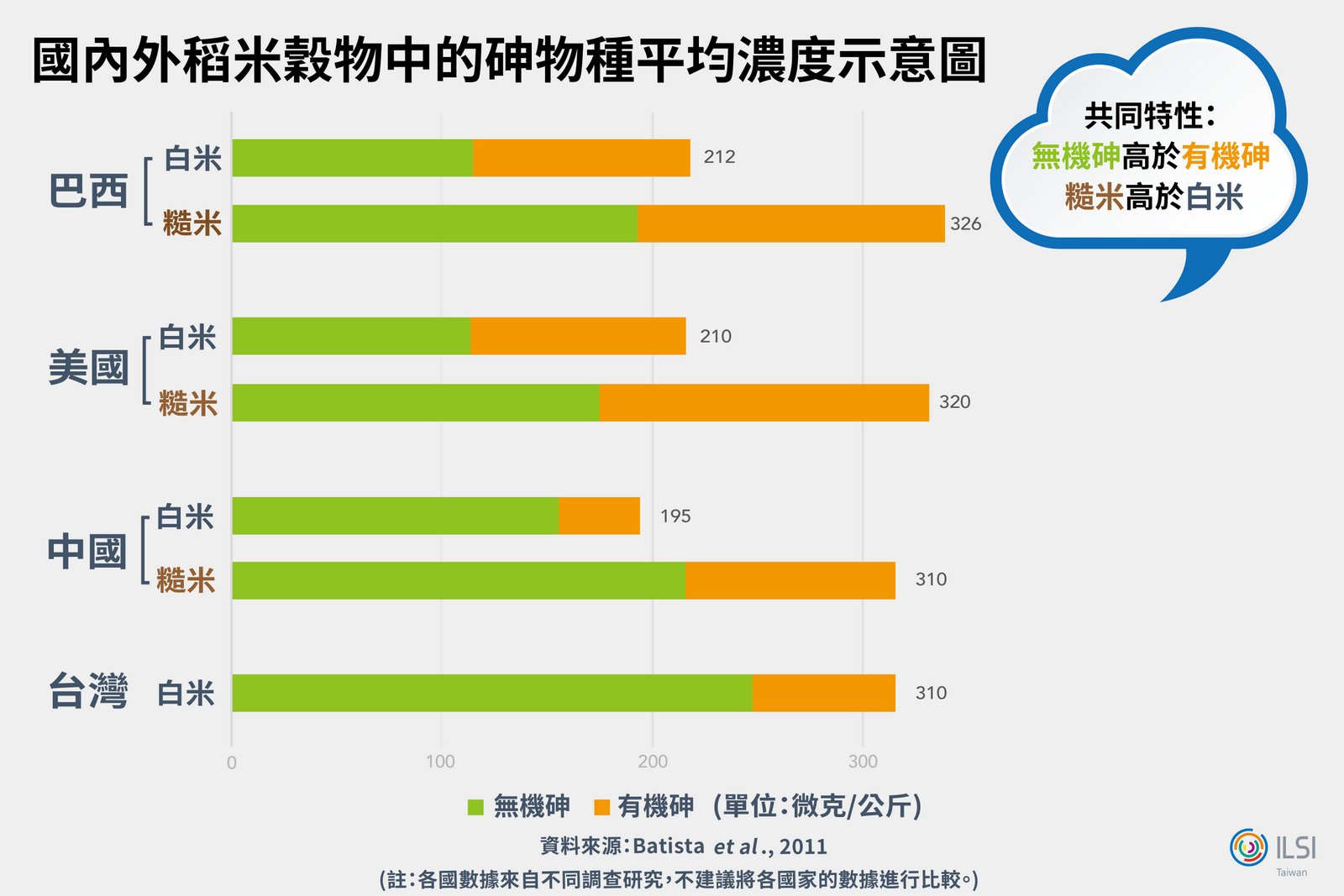
In 2013, the Food and Drug Administration of the Ministry of Health and Welfare sampled 65 cereal samples and 55 miscellaneous grain samples nationwide. The total arsenic analysis results showed that brown rice concentrations were higher than white rice, but the total arsenic concentration of all samples did not exceed the standard value of 1000 micrograms/kg (1 ppm) for arsenic content in edible rice set by the United Kingdom and Australia.
According to the risk assessment results of that project, children aged 0-3 ingested 5.41 micrograms of arsenic per kg of body weight, children aged 3-6 ingested 4.61 micrograms, and adults aged 19-65 ingested 2.14 micrograms of arsenic per kg of body weight per week. The arsenic doses ingested by all age groups from eating rice and miscellaneous grains were all less than the recommended intake of 15 micrograms per kg of body weight per week set by the Food and Agriculture Organization of the United Nations (FAO).
How can the risk of arsenic exposure in the diet be reduced?
Although the total arsenic concentrations of rice produced in Taiwan and imported rice are both lower than the total arsenic analysis results for international rice, and the average exposure doses for all age groups are lower than the recommended values of the Food and Agriculture Organization of the United Nations, for extreme dieters who consume excessive amounts of rice, there may still be potential health risks to the human body. It is recommended that ordinary households, when buying rice or other cereal products, take turns purchasing products of different brands, different origins or different stores to spread the risk. In addition, the public is urged to follow the principle of a balanced diet and reduce opportunities for long-term intake of a single type of food, so as to lower the risk of arsenic exposure.
※ References
[1] Batista BL, Souza JM, De Souza SS, Barbosa F Jr. Speciation of arsenic in rice and estimation of daily intake of different arsenic species by Brazilians through rice consumption. Journal of Hazardous Materials. 2011; 191: 342-348.
[ILSI Taiwan column writers]
Professor Chen Hsiu-Ling
PhD in Basic Medical Sciences from National Cheng Kung University; currently Professor at the Institute of Food Safety, Health and Risk Management at National Cheng Kung University and Deputy Director of the Environmental Trace Toxic Substances Research Center at National Cheng Kung University. Research specialties include food safety, risk assessment and environmental health.
Distinguished Professor Lee Ching-Chang
PhD from the Graduate Institute of Environmental Engineering at National Taiwan University; currently Distinguished Professor at the Department of Industrial Hygiene and Institute of Environmental and Occupational Health at National Cheng Kung University, Director of the Environmental Trace Toxic Substances Research Center at National Cheng Kung University, and a director of the Taiwan International Life Sciences Institute. Research specialties include health risk assessment and management of environmental toxicants, sampling analysis of environmental trace toxicants and exposure assessment.
(This article is reprinted from the ILSI Taiwan column, November 2017 issue)
1 mg/kg = 1000 micrograms/kg = 1 ppm