-

For Phalaenopsis grown in bark, is thick or thin bark better, and does it need to be soaked in advance?
Phalaenopsis is an epiphytic plant that likes a loose, breathable growing medium, and bark is a common choice. Some growers ask: for growing Phalaenopsis, is thick bark better or thin bark better? Does the bark really need to be soaked in advance before use? When it comes to choosing bark thickness, each has pros and cons, and the decision should be based on actual needs; pre-treatment before use also affects the plant's growth condition.
-

Things to Note When Buying Flowers Online and Green Plant Varieties Suitable for Online Shopping
Recently wanted to add some green plants to your home but can't be bothered to go to the flower market? Buying flowers online is indeed convenient, but if you don't pay attention when buying flowers, it's easy to step on landmines! Today let's talk about what to watch out for when buying flowers online, and also recommend a few green plants that are super suitable for online shopping - even beginners can buy them without worry! First, let's talk about what to note when buying flowers online.
-

Are lots of aerial roots on a Phalaenopsis a good thing, and what to do if there are too many
The Phalaenopsis has a naturally "maverick" character; other flowers hide their roots in the soil, but this one sends many roots straight out into the air, white and tender, looking quite distinctive. So are lots of these aerial roots a good thing or a bad thing? And if too many grow, will it affect flowering? The Phalaenopsis is by nature an epi
-

Toddler Rushed to ICU After Curiously Eating a Houseplant: Think Twice Before Keeping These Plants in Homes with Children
A couple of days ago I came across a news story: a three-year-old boy, while the adults weren't paying attention, grabbed a leaf off a houseplant and curiously chewed a couple of bites. Within half an hour he started vomiting and couldn't speak, and when he was taken to the hospital he went straight into the ICU. The doctor said that if he had arrived any later, he might not have been saved. The culprit turned out to be a houseplant the parents had casually placed in the living room.
-

A romantic secret lies within the bulbs of the giant allium (Allium giganteum), a striking touch that brightens all four seasons
The first time you see a giant allium in a garden, you are always moved by that "purple firework" rising out of nowhere - slender stems holding up plump flower globes, with sunlight filtering through the translucent petals, blending into a soft yet passionate glow. The story of the giant allium begins with a round, plump bulb. Unlike tulips and hyacinths, which are
-
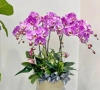
Don't panic if your Phalaenopsis orchid gets sun-scorched and wilts! This rescue method works better than randomly watering. How do you save a Phalaenopsis orchid that has wilted from sun exposure? First do 2 emergency steps, then do 3 things.
Everyone knows Phalaenopsis orchids like indirect light, but if you accidentally let them get too much sun, the leaves wilt and curl, and the edges even turn scorched black. It really hurts to see! Actually, after sunburn, don't panic. With timely emergency care, they can still be saved. The key is to focus on "shade, rehydration, and controlling the environment." Just like a person with sunburn needs to get out of the sun and apply moisturizer, Phalaenopsis orchids also need to be treated accordingly.
-

Pepperwood and Fragrant Pistacia Are Not the Same Thing: 3 Tricks to Tell Them Apart Easily
Recently someone asked: "I bought a fragrant pistacia online, why does it seem more and more off the longer I grow it?" Most likely you got cheated -- nine times out of ten you bought a pepperwood! These two look so much alike, and sellers love to mix them up, especially at the seedling stage; if you don't look carefully, you really can mistake one for the other. Today I'll teach you 3 tricks to tell them apart, so you'll never
-

Stephania and Pennywort Are Not the Same Thing: 5 Differences to Tell Them Apart
Some plant lovers always get confused when browsing a flower shop: "This round-leaved plant must be pennywort, right? Why does the shop owner call it Stephania?" Actually, although Stephania and pennywort both have somewhat "round" leaves, they are not the same plant at all. Whether in appearance, growth habit or care needs, the differences are huge! Today I will teach you to tell
-

Tired of root rot when growing flowers? Tuck a few small things into the pot for better airflow and drainage, and the roots will grow stronger
The biggest headache in growing flowers is root rot - you clearly don't water much, yet the plant still droops, and when you take it out of the pot it's all black, mushy rotten roots, heartbreaking and a waste. Actually, the core problem with root rot is just one thing: water accumulates in the pot and can't drain out, so the roots are smothered in wet soil and lack oxygen. Don't just blame yourself for being heavy-handed with the watering can - add some "small things" to the pot,
-

How do you grow figs on a balcony so they bear fruit? Just do these few things
A netizen grew a fig on their own balcony, and it actually bore fruit! This thing, it was like magic, instantly lighting up an ordinary life. Nowadays many people like to grow a few flowers and plants on the balcony, adding a bit of life to the home. This netizen was no exception; at first, they just thought of growing a fig on the balcony, just as a way to find a little fun in life. When it was bought, that fig sapling was tiny and frail-looking; who could have imagined it would later cause such a big stir? Previously everyone always thought figs had to be grown in a yard, but unexpectedly a balcony can also produce fruit. Today I have organized this netizen's experience, so flower lovers who want to try it should save it quickly!
条件筛选