-

How to Select and Plant Orchids? A Detailed Guide to Practical Methods
Some orchid enthusiasts ask: I buy orchids every spring and they die every year, what is the reason? As we know, orchids cultivated in the north are mostly seedlings transported from the various provinces south of the Yangtze River each spring. One reason they fail to survive is that the orchid seedlings suffer excessive root damage when lifted in their place of origin, and combined with long-distance transport and exposure to wind and sun, they are prone to cold and heat damage, causing their roots, stems and flowers to be injured to varying degrees, so the survival rate is not high. Another reason is improper care after planting, which causes the plants to wither and die.
-
What are the characteristics of Jianlan and Sijilan? Understand their care methods in one article
Sijilan is a type within the Jianlan series, also known as Xialan, Qiulan, and so on. Jianlan is mainly produced in Fujian, and Fujian was once hailed as the hometown of Jianlan. Jianlan is widely distributed, in areas south of the Yangtze River in China or along both banks of the Yangtze River basin, and on both sides of the central mountain slopes in Taiwan, China. In damp shaded places in forests or under mixed woods at altitudes below 1500 m, and in foggy places on south-facing mountain slopes...
-
Methods and Techniques for Selecting Orchid Growing Media
Chapter One, Principles. To grow orchids well, the first issue you will encounter is which growing medium to choose. To choose a good growing medium, you must first understand the growth characteristics of orchids. We know that the stomata on orchid leaves are sunken, so respiration is incomplete and the roots must also help with breathing; orchids mostly grow in places rich in humus with loose soil...
-
A Detailed Guide to the Classification Methods and Variety Characteristics of Chinese Cymbidiums
Terrestrial Orchids Terrestrial orchids are suited to growing in the loose soil layer on the ground surface. The terrestrial orchids native to our country are also called "Chinese cymbidiums," and they have high ornamental value and economic value. This article focuses on Chinese cymbidiums. Terrestrial orchids have poor seed propagation ability, and tissue culture is difficult; there are currently no successful reports. Therefore, although there are many types of terrestrial orchids...
-
How to Identify Orchid Roots? A Few Practical Identification Methods
The roots of orchids in the genus Cymbidium are relatively thick and fleshy. Generally, there is no distinction between a main root and lateral roots. The internal structure of orchid roots is a typical monocotyledonous type. Its cortical cells are relatively well developed, and it has symbiotic fungi called root fungi. Those growing underground are called terrestrial roots, and those growing in the air are called aerial roots. Whether terrestrial roots or ae...
-
To identify orchid varieties, master the three-look method
Variety identification is an appraisal of an orchid's overall qualities and the branch of knowledge that best demonstrates a grower's skill. For this reason, orchid masters through the ages have been especially cautious about it, never jumping to conclusions, and have always upheld the "three looks" principle. First, look at the leaf shape: "enjoy the flowers for a time, admire the leaves all year round." In the flowerless season, people identify famous orchid varieties...
-
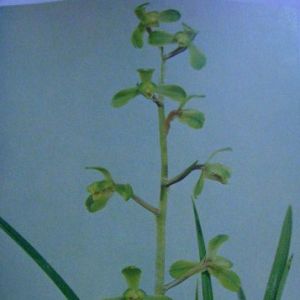
Introduction to the Characteristics and Care Methods of the Zheding Huilan Orchid Variety
Petal type: Red-shell plum petal. Characteristics: The three outer petals are short and round with tight edges, a separated silkworm-moth lip, and a large round tongue. The flower has level shoulders, is emerald green in color, with pinkish coloration at the petal base; the flower form is large and the texture is glutinous. The leaves are relatively broad, emerald green, and glossy.
-
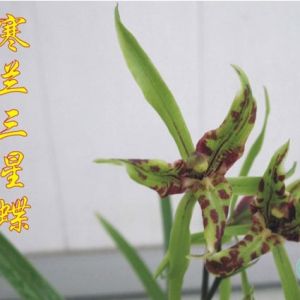
Characteristics and Care Methods of the Three-Star Butterfly Cymbidium kanran
The leaves are semi-pendulous and slender, belonging to the fine-leaf Cymbidium kanran type. The leaf color is dark green, the leaf margins are smooth, and the leaf bases spread outward, giving the whole plant an elegant, flowing appearance. The flower stalk is crimson red, the bracts at the flower base are green, the petals are bamboo-leaf shaped, the lip petals are butterfly-transformed, with red spots on a green background; the flower colors are brilliant and showy, making it a standard Three-Star Butterfly.
-
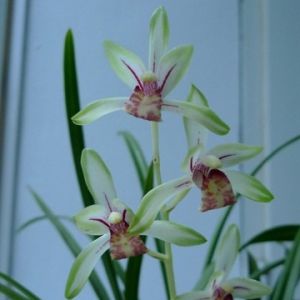
Characteristics of the Caifeng Cymbidium ensifolium variety and an introduction to its care methods
The mountain-collected origin is unknown; it was selected in Shantou. Caifeng is a bicolor-flowered Cymbidium ensifolium. Its leaf buds show a green outer rim with a yellow-centered translucent pre-emergent pattern; by the time the growth matures, some leaves gradually turn green, while others carry a slight yellow stripe pattern. The leaves are soft and smooth, medium-short and semi-arching, with an elegant, graceful posture. The flowers rise above the leaves, with several flowers per scape, cat-ear-shaped petals (pouch petals), each with a brilliant...
-
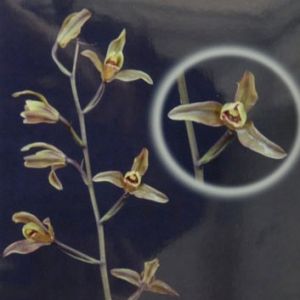
Introduction to the Care Methods for Bougainvillea and Cold Orchid
Plum-petal Cold Orchid Bougainvillea
条件筛选