-

Feed Formulation and Processing Techniques for Medicinal Silkworm Larvae Infected with Beauveria bassiana
Currently, medicinal silkworm larvae infected with Beauveria bassiana are in strong demand on the Chinese medicinal herb market, and raising and processing them is profitable. The methods for raising and processing them are: 1. Rearing the mature silkworms. Raising and processing medicinal silkworm larvae infected with Beauveria bassiana should be carried out as a specialized operation in non-cocoon-producing areas, so as to avoid a devastating impact on cocoon silkworms. The raising and processing can be carried out throughout the year. As for the feed, besides a small amount of mulberry leaves, more evening primrose, Jiancan grass, white clover, cup plant (Silphium perfoliatum) and the like can be added to replace mulberry leaves, so as to supplement the shortage of mulberry leaves and reduce feeding costs. For
-
Rearing Methods and Management Key Points for Male Silkworm Larvae
I. New Hybrid Male Silkworm Varieties (1) Variety characteristics. The new autumn-rearing male silkworm variety Qiuhua x Ping 30, bred by the Sericulture Research Institute of the Zhejiang Academy of Agricultural Sciences, has the advantages of a strong constitution, uniform molting and rising in each instar, and being easy to rear. The number of silkworm larvae per gram is about 2310, the 5th instar lasts 6 days and 18 hours, the whole instar lasts 22 and a half days, the two-day hatching rate is 49.34%, the silk length is about 1240 m, the cocoon shape is oval, large and uniform, the cocoon color is pure white, and the cocoon shell rate and silk yield are high. (2) Key points of rearing technology. For gathering newly hatched silkworms, light exposure can be
-
What pesticide gives the best control effect against older larvae of the rice leaf roller?
Chlorpyrifos and abamectin-monosultap are effective agents for controlling the rice leaf roller, but they must be applied during the 1st-2nd instar young larval stage (at this stage the rice leaf roller has not yet rolled leaves and caused damage, or has just begun rolling the leaf tips and causing damage), when the rice in the field has just begun to roll leaves. For rice leaf roller larvae of the 3rd instar and above, on the one hand they are protected because they are wrapped inside the rice leaves, and on the other hand they are insensitive to nereistoxin-type pesticides such as monosultap and to organophosphorus pesticides such as chlorpyrifos, methamidophos and monocrotophos, so the control effect after spraying is poor. Relatively speaking, older rice leaf
-
Rearing Methods and Technical Key Points for Male Silkworm Larvae
I. New Hybrid Male Silkworm Varieties (I) Variety Traits. The new autumn-rearing male silkworm variety bred by the Sericulture Research Institute of the Zhejiang Academy of Agricultural Sciences - Qiuhua x Ping 30, has the advantages of a strong constitution, uniform molting and rising at each instar, and being easy to rear. The number of ants per gram is around 2310, the 5th instar takes 6 days and 18 hours, the whole larval stage takes 22 and a half days, the two-day hatching rate is 49.34%, the silk length is around 1240 m, the cocoon shape is oval, large and uniform, the cocoon color is pure white, and the cocoon shell rate and silk yield are high. (II) Key Points of Rearing Technology. For ant reception and light exposure, this can appropriately be done earlier than for common varieties.
-
How can sheep bot fly larvae disease be treated effectively?
Sheep bot fly larvae disease mainly affects sheep and goats. This disease mainly occurs from early autumn to mid-autumn. After infection, the sheep become restless, showing symptoms such as shaking the head, running around, and lowering the head to press the tip of the nose against the ground; some hide their heads under the bellies of other sheep. Treatment: (1) In early autumn, when adult flies fly and deposit larvae, an insecticidal ointment can be applied to the sheep's nose and nostrils once every 7 days to prevent adult flies from depositing larvae. (2) Spray 60 ml of 3% Lysol solution into the sheep's nostrils once a day for 7 consecutive days; the curative effect is excellent.
-
Control Methods and Medication Tips for Powdery Mildew, Brown Spot and Stem Borer Moth on Dahlia pinnata
Pest and disease control methods for Dahlia pinnata: powdery mildew breaks out heavily from September to October, control it with antifungalmycin 120; brown spot occurs from June to August, spray Bordeaux mixture or chlorothalonil; for viral diseases, prevent aphids and leafhoppers from transmitting the virus; for stem borer moth larvae, spray fenitrothion, so that Dahlia pinnata blooms more brilliantly.
-
Can You Eat Bayberry If It Has Worms? Salt Water Soaking to Remove Worms and Cleaning Methods
The small white worms in bayberry are fruit fly larvae, basically harmless and safe to eat. This article introduces the method of soaking in salt water for 10 to 20 minutes to remove the worms, cleaning bayberry with cornstarch water, as well as tips for selecting fresh bayberry and its ripening time, to help you enjoy it with peace of mind.
-
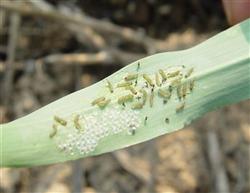
What pesticide is effective for controlling rice stem borer larvae?
What pesticide should be used to control rice stem borer larvae? For controlling rice stem borer larvae, you can use 30 to 40 ml of 5% fipronil suspension concentrate per mu, or 120 to 150 ml of 20% triazophos emulsifiable concentrate plus Tianda 2116. When using chemical control, maintain a 3 to 5 cm deep water layer in the field and let it dry naturally. Click to get more insecticide...
-

What do dragonfly larvae eat? A detailed guide to common food types
What food do dragonfly larvae eat?
-
How to breed chironomid larvae? Detailed explanation of breeding methods and techniques
How to breed chironomid larvae?
条件筛选