-

Can old Phalaenopsis (moth orchid) plants still be kept? An explanation of why we prune
A flower-growing friend asked: if a Phalaenopsis has been kept at home for several years and is now an old plant, should it be thrown away? And what is pruning all about? As time goes on, a Phalaenopsis gradually enters "old age"; after growing for many years and becoming an old plant, its growth vigor weakens. Old Phalaenopsis plants can absolutely continue to be grown! Although old plants are not as young and vigorous as new ones
-

Is carbendazim for flowers and plants harmful to humans? A detailed explanation of its effects and uses
For experienced gardeners, the proper use of fungicides is the most ordinary thing. But for novice flower lovers, they are often prone to gullibly trusting online tutorials, and carelessly get the frequency of use wrong, causing the opposite effect. So, regarding the most common methods of using carbendazim, what issues need attention
-

Can Phalaenopsis Roots Photosynthesize? A Detailed Explanation of Their Functions and Roles
Phalaenopsis (moth orchid) is famous for its flowers. People tend to focus their attention on its gorgeous blooms, yet rarely notice its unique root system. So do Phalaenopsis roots photosynthesize? And what functions do they have? Phalaenopsis is an epiphytic plant, and its roots are completely different from the roots of common plants that grow in soil - they are aerial roots.
-

How many types of roots does a Phalaenopsis orchid have? A detailed explanation of root functions
In the vast and diverse world of flowers, beyond its stunning blooms, the Phalaenopsis orchid's root system is equally full of mystery. These roots of varying forms are not only key to the plant's survival but also carry unique biological functions. From appearance and function, Phalaenopsis roots can mainly be divided into aerial roots and underground roots, but as a typical
-

How Does the Phalaenopsis Absorb Nutrients? A Detailed Explanation of Its Nutrient Sources
The Phalaenopsis, the "beauty icon" among orchids. The question of how Phalaenopsis absorbs nutrients and what it relies on to absorb them may not be familiar to everyone. Behind its beautiful blooms, an efficient nutrient absorption mechanism plays a key role. So where exactly does the Phalaenopsis absorb nutrients from? And what does it rely on to complete
-

What Happens When a Phalaenopsis Orchid Lacks Water? A Detailed Explanation of Symptoms Such as Yellowing Leaves
During the care of Phalaenopsis orchids, water management is a key part. When a Phalaenopsis orchid is short of water, the plant faces a series of survival challenges, and whether yellowing leaves are caused by lack of water is a focus of attention for many gardening enthusiasts. Effects of insufficient water on Phalaenopsis orchids: stunted growth and development: the physiological activities of the Phalaenopsis orchid, from
-

Should Phalaenopsis Be Divided? A Detailed Explanation of Blooming After Division
In the care of Phalaenopsis, does it need to be divided and grown separately? Can the divided plants still continue to bloom beautiful flowers? These questions not only relate to the propagation and cultivation of Phalaenopsis, but also affect every flower grower's expectation of harvesting abundant blooms. As an epiphytic orchid, Phalaenopsis often attaches to tree trunks in the natural environment
-

Are Spiraea and Snow Willow the Same Plant? A Detailed Explanation of the Differences Between the Two
Spiraea and Snow Willow are two plants with their own distinctive characteristics. On closer observation, the two show clear differences in many respects. Next, let's look at the following aspects to help everyone easily tell them apart. In terms of plant classification, Snow Willow belongs to the genus Fontanesia in the family Oleaceae, and plants of this family and genus often share the unique characteristics of Oleaceae plants.
-
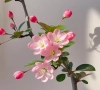
How to Tell the Difference Between Hall Crabapple and Cherry Blossom Trees? A Detailed Explanation of Their Differences
In spring, Hall crabapple and cherry blossoms are easy to confuse when they bloom. Below, we explain their differences from several aspects. In botanical classification, Hall crabapple belongs to the genus Malus in the rose family (Rosaceae) and is a plant native to China; cherry blossom belongs to the rose family (Rosaceae), broadly to the genus Prunus and narrowly to the genus Cerasus. Although both belong to the rose family, they are further distinguished
-

How do you grow Phalaenopsis seedlings so they grow fast? Detailed explanation of fertilizer mixing methods
I believe Phalaenopsis is a favorite of many flower growers, because it has so many varieties that they make your eyes dazzle, such as Golden Princess, Green Bear, and others. Moreover, no matter the variety, once the flowers bloom they are like dancing butterflies, very interesting. Another reason many people like it is of course that the flowering period is long enough. Generally speaking, even non-professionals
条件筛选