-
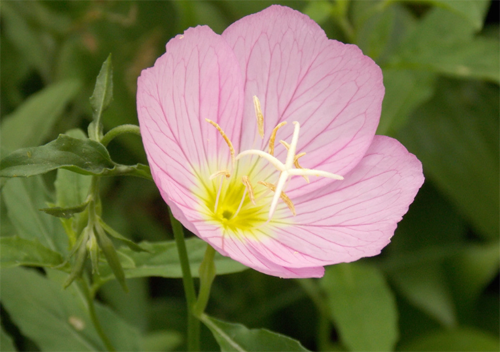
A Detailed Guide to Growing Evening Primrose: Methods and Benefits
When evening primrose blooms, it is very beautiful and lovely. If you want to grow evening primrose yourself, how should you grow it? What benefits and effects does evening primrose have? Take a look and you will know: Growing methods for evening primrose: evening primrose is drought-tolerant, cold-tolerant, and tolerant of poor soil.
-

Evening primrose, tuberose, mountain sesame, wild sesame
Scientific name: Oenothera biennis. Common names: tuberose, mountain sesame, wild sesame. Type: perennial herbaceous plant. Origin: native to North America, introduced to Europe and then spread throughout the world. Family and genus: Onagraceae, genus Oenothera. Growth characteristics: evening primrose is cold-tolerant, drought-tolerant, tolerant of poor soil, light-loving, and intolerant of waterlogging; bolting and flowering require a certain low-temperature stimulus. Morphological characteristics: biennial plants are 100-140 cm tall; annual plants are 60-90 cm tall. Basal leaves grow in a rosette
-
How to Grow Primroses? A Detailed Guide to Primrose Cultivation Techniques
Primrose (Primula spp.), also known as yingcao or nianjinghua, belongs to the family Primulaceae and the genus Primula. It is widely cultivated around the world and has developed rapidly in recent years, becoming an important garden flower. Blooming in early spring is an important characteristic of this genus. (I) Morphological characteristics and species: perennial herbaceous plants with persistent roots, but most are cultivated as annual or biennial flowers. The plants are low-growing, with all leaves basal, forming a rosette-like leaf cluster. Flowers come in red, yellow, orange, blue, purple, white and other colors, arranged on the flower buds in
-
What are the control methods for primrose leaf spot disease?
Symptoms The disease occurs on the leaves. The spots are usually 3-4 mm in diameter and brown; in severe cases, the diseased leaves wither and die, causing defoliation. The disease spreads from the lower leaves to the upper leaves. The pathogen is Ramularia primulae Thumen, the primrose Ramularia fungus. It belongs to the Deuteromycotina fungi. The conidiophores emerge from the stomata, growing in clusters of several branches, very short, unbranched, colorless, with slightly curved tips; the conidia are cylindrical or short club-shaped, single-celled or two-celled, colorless, measuring 16-24 x 3-4 micrometers. Transmission routes and conditions for disease development
-
What are the control methods for leaf spot disease in primroses?
Control of leaf spot disease in primroses: 1. Select and breed disease-resistant varieties. 2. Strengthen fertilizer and water management, apply more organic fertilizer and phosphorus-potassium fertilizer, and avoid over-applying or applying excessive nitrogen fertilizer alone. 3. After the disease first appears at the seedling stage, begin spraying 70% thiophanate-methyl wettable powder at 1000 times dilution plus 75% chlorothalonil wettable powder at 1000 times dilution, or 50% sulfur mixture suspension or 36% thiophanate-methyl suspension at 500 to 600 times dilution, or 1:1:100 Bordeaux mixture.
-
Symptoms and Control Methods of Botrytis Blight in Primroses
Botrytis blight is a common and widespread disease of primroses. [Pathogen] Botrytis cinerea Pers. et Fr. [Symptoms] Water-soaked spots appear at leaf tips or leaf margins, then gradually enlarge, turn brown to black, and rot; stems develop irregular brown lesions and are prone to soft rot; flowers turn brown, rot, and drop off. In the late stage of the disease, a grayish-brown mold layer forms on the affected parts. [Disease cycle] The pathogen overwinters in diseased plant residues or in the soil. Conidia are spread by wind and rain
-
What should be done if a primrose gets anthracnose?
[Pathogen]Colletotrichum primulae, a fungus belonging to the Deuteromycotina subdivision and the genus Colletotrichum. [Symptoms]Brown round or nearly round spots appear on the leaves, and later sparse small black dots arranged in rings form on the spots; these are the pathogen's acervuli. [Occurrence pattern]The pathogen overwinters on infected fallen leaves, and conidia spread by wind and rain and enter through wounds. [Epidemic characteristics]Higher humidity favors the occurrence of the disease or aggravates the condition. [Control measures
-
How to prevent and control bacterial leaf spot in primroses
Symptoms On the common primrose (Primula malacoides), leaves and flower receptacles are affected. Initially, water-soaked irregular lesions form along the leaf veins, which later turn yellow, then the lesions turn brown, enlarge, and marginal blight symptoms occur. In severe cases, the lower leaves die. On the polyanthus primrose, dark water-soaked spots initially form on the leaves, which later turn light brown with a distinct yellow halo around them. Pathogen: Pseudomonas syringae pv. primulae (Arke et Gardner) Young, Dye et Wilkie
-
What are the control methods for primrose brown spot disease?
Symptoms are prone to occur on the fairy primrose (Primula malacoides). Brown spots form on the leaves. The pathogen Alternaria sp. belongs to the deuteromycete Alternaria fungi. Transmission route: conidia are spread by wind and rain. Control method: spray fungicides such as 70% chlorothalonil wettable powder at 1000 times dilution in the early stages of the disease.
-
A Detailed Guide to the Prevention and Control of Brown Spot Disease in Primroses
Symptoms are prone to occur on the fairy primrose (Primula malacoides). Brown spots form on the leaves. The pathogen Alternaria sp. belongs to the deuteromycete Alternaria fungi. Transmission route: conidia are spread by wind and rain. Prevention and control method: spray 70% chlorothalonil wettable powder at 1000 times dilution or other fungicides at the early stage of the disease.
条件筛选