-

How to water bark-grown Phalaenopsis orchids in summer and do they need more water?
As soon as summer arrives, the pots of those Phalaenopsis orchids planted in bark dry out completely - time to water? But I've heard that Phalaenopsis roots are delicate and too much water easily causes root rot... This punishing summer, what on earth should be done with them? Bark-grown Phalaenopsis orchids can't just be watered carelessly in summer. Bark has excellent air permeability, and when watered too much
-

Do Phalaenopsis leaves need to be fixed in place, and will uneven leaves affect blooming?
In the early morning, while watering your Phalaenopsis, you stare at a leaf leaning to one side and think, "Why are these leaves so uneven? Should I tie them up with string? Will this affect blooming?" Phalaenopsis is an epiphytic plant, naturally growing on tree trunks or rocks, and its leaves stretch out toward the light (this is called "phototropism"), so a slight tilt is actually its normal response to "looking for the sun."
-

Does watering a Phalaenopsis orchid need to be done differently by season? A breakdown of watering methods for different seasons
Is watering the most headache-inducing part of growing Phalaenopsis orchids? Some people are never sure: "Is watering a Phalaenopsis the same all year round?" Today let's be blunt - watering a Phalaenopsis must be done differently by season! The watering routines for different seasons are worlds apart, and if you get it wrong, root rot can show up in no time! Let's start with spring. At this time, the Phalaenopsis
-

Do Phalaenopsis orchid leaves need regular pruning, and when is the best time to prune?
In the morning, squatting on the balcony watering the flowers, you look down and see that pot of Phalaenopsis orchid with several leaves crowded together, one of them with a tip as yellow as scorched paper and slightly curled edges - doesn't this scene feel so familiar? Many friends who grow Phalaenopsis orchids ask: "Do the leaves need to be pruned regularly?" "Will it die if I prune wrong?" Phalaenopsis orchid leaves
-

What to do when a Phalaenopsis orchid grows a young offshoot on its side, and does it need to be divided into a separate pot?
A perfectly healthy Phalaenopsis orchid suddenly sprouts a small tender shoot on its side. It looks quite cute, but you are not sure what to do with it. Should you keep this little offshoot or remove it? Should you hurry to divide it into its own pot? Phalaenopsis orchids are different from other flowers: their side shoots usually grow on the flower spike, and sometimes they also emerge near the roots. This shows that your Phalaenopsis has been kept
-

What kind of Phalaenopsis roots need pruning? Learn to tell when it's time to trim roots
Growers of Phalaenopsis orchids have surely noticed its plump roots, some translucent like jade, others wrinkled and blackened; in fact, the state of these roots hides quite a few little secrets. Today let's talk about what kind of roots should be cut, and how to judge whether it's time to act - you'll understand at a glance. Which roots absolutely must be "snip"-ed off? The most obvious are
-

Which potted plants do not need sunlight? Four small potted plants with low watering frequency
Insufficient indoor light and low watering frequency? These four potted plants do not need frequent sunlight, nor do you have to constantly remember to water them. They are suitable for busy people or beginners, and are simply a blessing for renters and overtime workers. Even if you occasionally forget to take care of them, they can still live quite vigorously. Small-leaf red nanmu: Small-leaf red nanmu (Syzygium buxifolium) looks especially delicate, with small oval leaves that are glossy green, and from a distance it looks like a mini forest. The best part is that it is not picky about light, so it can be placed in a corner of the living room or beside a desk, as long as it is not completely pitch-black. Watering is even more worry-free; water only after the soil has dried out completely, about once every ten days or so is enough, in summer when evaporation is fast at most once a week, and in winter once every half month is no problem. I once kept one, went on a business trip for half a month without tending it, and when I came back it still looked vigorous, just a little wilted leaves, and after a bit of water it perked up the next day, very easy to keep.
-

Do Phalaenopsis seedlings need to be divided into separate pots, and can the old plant still survive?
A little seedling has popped up in the Phalaenopsis pot - should it be divided into its own pot or not? Will dividing it harm the old plant? But if it's not divided, the seedling might get crowded and not grow well. Today let's talk about this - all practical experience, easy for beginners to understand too. When a Phalaenopsis seedling first emerges, don't rush to move it - it hasn't yet developed "independence." You
-
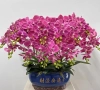
When does a Phalaenopsis need repotting? Repotting time and method
When growing Phalaenopsis, repotting is a key step that affects their growth and flowering. To judge whether repotting is needed, you can observe three aspects comprehensively: the root system, the potting medium, and the growth performance. At the same time, managing the details before and after repotting is what keeps the plant in a vigorous state at all times. 1. Root system condition - root explosion phenomenon: when the roots are densely tangled inside the pot
-

Why do old Phalaenopsis (moth orchid) plants need repotting, and can they survive without it?
Anyone who grows Phalaenopsis knows that after a year or two the plant becomes an old specimen: the leaves are no longer so perky and it blooms less. At this point some people say "it's time to repot," while others think "leave it alone, what if moving it kills it?" So why do old plants really need repotting? Can they truly not survive without it? Why do old plants have to move house? The
条件筛选