-

What kind of colorful-leaf tree is the golden-leaf honeylocust?
Golden-leaf honeylocust (Gleditsia triacanthos 'Sunburst') is a plant in the genus Gleditsia of the family Caesalpinioideae. A broadleaf deciduous tree, it grows rapidly and has no branch thorns; the young leaves are golden yellow, the mature leaves light yellow-green, and in autumn they turn golden yellow. Its branches spread out gracefully, giving it a beautiful form, and it does not produce fruit. The honeylocust has strong adaptability, prefers light but tolerates slight shade, drought and cold, and can withstand low temperatures of around -25°C. It likes a warm, humid climate and deep, fertile, appropriately moist soil
-
Golden-leaf dawn redwood is a new and superior colored-leaf tree species
Dawn redwood (Metasequoia glyptostroboides) is the only surviving species of the genus Metasequoia in the family Cupressaceae. This species was once thought to be extinct, until it was discovered in 1941 in the Lichuan area of Hubei, China, and afterwards this plant was also found successively in the Wanxian area of Sichuan. In 1947, dawn redwood seeds were introduced to the Arnold Arboretum in the United States, and from there spread to botanical gardens around the world. In 1948, "dawn redwood" and its scientific name were formally named, and since then it has enjoyed great fame in China and even the whole
-
Phlox, Drummond phlox, annual phlox, five-color plum, grass oleander, campanula pink, foreign plum flower, small foreign flower, small sky-blue hydrangea
Scientific name: Phlox drummondii. Aliases: phlox flower, phlox bloom, five-color plum, grass oleander, campanula pink, foreign plum flower, small foreign flower, small sky-blue hydrangea. Family and genus: Polemoniaceae, Phlox genus. Origin: native to southern North America, now widely cultivated in countries around the world. Origin of the name: the genus name Phlox means flame, because the original species of phlox has red flowers. The species name honors Drummond. Morphological characteristics: plant height 15 to 45 cm. Stems erect, much branched
-
What are the other names for Phlox drummondii? Phlox flower, five-color plum, grass oleander, etc.
Scientific name: Phlox drummondii. Other names: phlox flower, phlox, five-color plum, grass oleander, bellflower pink, foreign plum flower, small foreign flower, small sky-blue hydrangea. Family and genus: Polemoniaceae, Phlox genus. Origin: native to southern North America, now widely cultivated around the world. Origin of the name: the genus name Phlox means flame, because the original species of Phlox has red flowers. The species name was given to commemorate Drummond. Morphological characteristics: plant height 15 to 45 cm. Stems erect, much branched,
-
Golden Privet: Introduction to a New Colorful-Leaf Plant Variety
Golden Privet: also known as Howard's privet, Ligustrum japonicum 'Howardii', a new colorful-leaf variety in the Japanese privet series. Evergreen shrub or small tree; leaves leathery, thick, with a fleshy feel; new leaves in spring are bright yellow, turning golden yellow by winter, and some new leaves have cloud-like light green patches along both sides of the midrib or locally on one side, with bright and pleasing colors; internodes short, branches and leaves dense. The original species is distributed from west of Kanto in Japan, Honshu, Shikoku, Kyushu, and Taiwan, China. It likes light, is drought-tolerant and cold-tolerant, and can grow in acidic,
-
Golden Locust is an excellent colored-leaf tree species
Robinia pseudoacacia 'Frisia', of the Fabaceae family, genus Robinia, is a broadleaf deciduous tree. The twigs are thorny, with pinnate compound leaves; the foliage is golden yellow in spring, turning yellow-green in summer and orange-yellow in autumn, with rich and extremely beautiful color changes. It blooms in early summer, with white flowers. Native to northern America, it loves sunlight, tolerates slight shade when young, and can adapt to acidic, calcareous and alkaline soils; it has a shallow root system, is not tolerant of waterlogging, and grows rapidly. It is suitable for growing in the Three-North region. It is suitable as a specimen landscape tree and
-
Natural color-enhancing feeds for laying hens include pine needles, black locust leaves and mugwort leaves
Pine needle powder: made by air-drying and grinding pine needles. Generally, adding 3 percent to 5 percent to the feed gives a good color-enhancing effect, and can increase the egg production rate by 13 percent. Black locust leaf powder: the added amount of black locust leaf powder accounts for 5 percent of the feed, and the effect is better than pine needles; the yolk color can be raised from grade 1 to grade 9 and can remain stable without changing. Mugwort leaf powder: mugwort leaves contain nutrients such as fat, protein and various amino acids. Adding 2 percent to 3 percent mugwort leaf powder to the chicken diet can increase egg production by 12 percent to
-
Unique and Colorful: A Brief Discussion of Butterfly-Type Floral Art in Chinese Cymbidiums
The "butterflies" among Chinese orchids, in all their myriad forms, have formed one of the most captivating groups in Chinese cymbidiums, collectively known as "Chinese Cymbidium Butterfly-Type Floral Art." Concept: In the flowers of Chinese cymbidiums, if 2 sepals (lateral sepals) or 2 petals (petals) undergo partial or complete mutation into a lip, then the flower colors of this type of orchid become richer and more varied. Usually the lip-transformed perianth segments bear colors such as green, white, red, and pale yellow. These mutated perianth segments curl backward or outward at the tip just like a lip (labellum), and their shape and color resemble butterfly
-
Crystal Grass Emerald Jade Plum of Douban Orchid, with lovely flower colors
Douban Orchid, also called Line-art Spring Orchid, as a member of the large family of Chinese orchids, has a long history of cultivation in Yunnan Province, with many varieties, wide distribution and rich resources. After years of selection, cultivation, development and utilization by orchid circles, some excellent varieties have appeared among Douban Orchids, attracting the attention of the orchid world and increasingly favored by orchid art lovers at home and abroad. Among them, Emerald Jade Plum, developed by Mr. Zhang Qilin, standing director and deputy secretary-general of the Dali Prefecture Orchid Association, combines crystal flowers, plum petals, flying shoulders, hard lips, crystal-clear color and strong fleshy texture
-
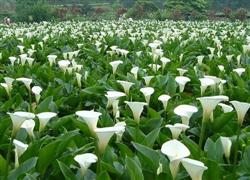
What are the common pests and diseases of colored calla lilies?
The common diseases of colored calla lilies mainly include bacterial diseases, fungal diseases and pest damage, which are introduced separately below. Bacterial disease Erwinia: Erwinia disease, also known as soft rot, is caused by the pv. carotovora pathovar of Pectobacterium carotovorum subsp. carotovorum. Infected leaves and stems turn dark green, with necrotic spots and rotting spots...
条件筛选